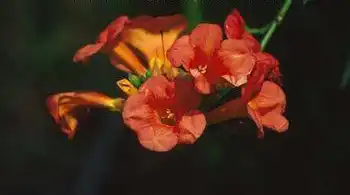
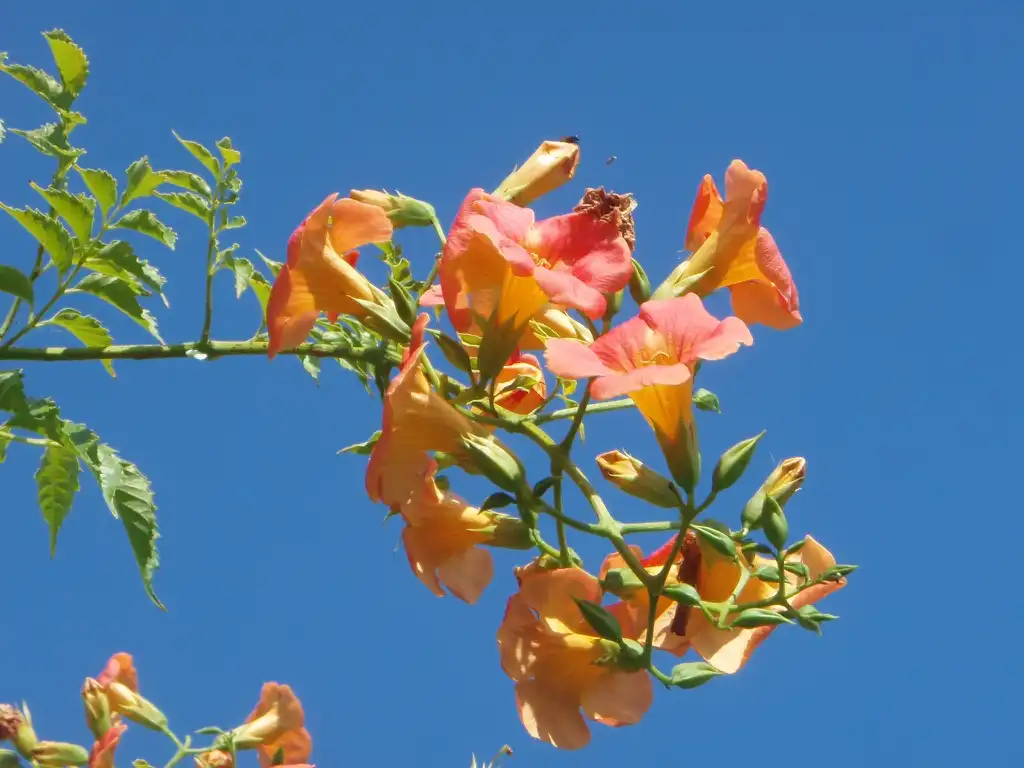
• Photo of Campsis grandiflora (Campsis grandifloras)

Plant Profile: Campsis grandiflora

Taxonomy: Campsis grandiflora

Names

Chinese Trumpet Creeper, Trumpet Vine

  • Photo of Campsis grandiflora (Campsis grandifloras)

Phonetic Spelling:KAMP-sis gran-dih-FLOR-uh

Genus:Campsis

Species:grandiflora

Family:Bignoniaceae

This deciduous vine ascends using aerial or adventitious rootlets. It produces large, vibrant flowers that range from deep orange to red, blooming from July until the first frost. Compared to C. radicans, it is less aggressive in its growth. Additionally, this plant shows mild resistance to deer damage. It requires support for climbing, exhibits partial twining, and has fewer aerial roots.

**Quick Identification Tips:**
The rootlets of this species are less numerous than those of C. radicans. Most plants available in the market are likely Campsis x tagliabuana, a hybrid of this species and C. radicans. To promote new flower growth and prevent fruit formation, it is advisable to remove spent flowers.

This vine is tolerant of various soil conditions and salt, grows rapidly, and does not face significant issues with pests or diseases.

Campsis grandiflora Feature Summary

Campsis grandiflora Image Gallery

Tags

#showy flowers
#deciduous
#red flowers
#orange flowers
#fast growing
#trellises
#vines
#climbing vines
#deer resistant
#landscape
#trumpets
#fantz

Similar Plants

Campsis grandiflora is often confused with:

Campsis grandiflora Feature Summary

Attributes
Fruit
Are elongate, pendulous, bean-like follicles.
Follicle
Flowers
In a terminal panicle with 6-8 elongate trumpet flowers. Orange to red, zygomorphic; calyx 5-lobed, lobes lanceolate; corolla an elongated trumpet-shaped tube, rich orange outside, yellow within, to 3" long x 1" diam., lobes 2-lipped, broad, obtuse, rich yellow.
Pink
Gold/Yellow
Red/Burgundy
Orange
Summer
Fall
Winter
Leaves
Opposite, pinnately compound, glabrous, 7-9 leaflets; leaflets elliptic to ovate-oblong, acute, cuneate to subrotund, coarsely serrate.
Compound (Pinnately , Bipinnately, Palmately)
Elliptical
Ovate
Oblong
Whole Plant Traits
Cultural Conditions
Full sun (6 or more hours of direct sunlight a day)
Landscape

Campsis grandiflora Attributes

Campsis grandiflora: Country Or Region Of Origin

Eastern China to Japan
Campsis grandiflora: Climbing Method

Clinging
Scrambler
Tendrils
Twining

Campsis grandiflora Fruit

Campsis grandiflora: Fruit Description

Are elongate, pendulous, bean-like follicles.

Campsis grandiflora: Fruit Type

Achene
Aggregate
Berry
Capsule
Caryopsis
Drupe
Follicle
Legume
Nut
Pome
Samara
Schizocarp
Siliqua

Campsis grandiflora Flowers

Campsis grandiflora: Flower Description

In a terminal panicle with 6-8 elongate trumpet flowers. Orange to red, zygomorphic; calyx 5-lobed, lobes lanceolate; corolla an elongated trumpet-shaped tube, rich orange outside, yellow within, to 3" long x 1" diam., lobes 2-lipped, broad, obtuse, rich yellow.

Campsis grandiflora: Flower Color

filter_vintage
Gold/Yellow
filter_vintage
Orange
filter_vintage
Pink
filter_vintage
Red/Burgundy

Campsis grandiflora: Flower Inflorescence

Catkin
Corymb
Cyme
Head
Insignificant
Panicle
Raceme
Solitary
Spadix
Spike
Umbel

Campsis grandiflora: Flower Bloom Time

Winter
Spring
Summer
Fall

Campsis grandiflora Leaves

Campsis grandiflora: Leaf Description

Opposite, pinnately compound, glabrous, 7-9 leaflets; leaflets elliptic to ovate-oblong, acute, cuneate to subrotund, coarsely serrate.

Campsis grandiflora: Woody Plant Leaf Characteristics

Broadleaf Evergreen
Deciduous
Needled Evergreen
Semi-evergreen

Campsis grandiflora: Leaf Type

Compound (Pinnately , Bipinnately, Palmately)
Fronds
Needles
Sheath
Simple

Campsis grandiflora: Leaf Arrangement

Alternate
Opposite
Other/more complex
Rosulate
Whorled

Campsis grandiflora: Leaf Shape

Acicular
Auriculate
Cordate
Cuneate
Deltoid
Elliptical
Filiform
Lanceolate
Linear
Oblanceolate
Oblong
Obovate
Obtuse
Orbicular
Ovate
Palmasect
Palmatifid
Peltate
Pinnatifid
Pinnatisect
Reniform
Rhomboidal
Spatulate
Subcordate
Subulate

Campsis grandiflora: Leaf Margin

Crenate
Crenulate
Dentate
Denticulate
Doubly Crenate
Doubly Dentate
Doubly Serrate
Entire
Lobed
Serrate
Sinuate
Undulate

Campsis grandiflora: Hairs Present

No
Yes

Campsis grandiflora Whole Plant Traits

Campsis grandiflora: Plant Type

Annual
Bulb
Carnivorous
Edible
Epiphyte
Fern
Ground Cover
Herb
Herbaceous Perennial
Houseplant
Mushroom
Native Plant
Ornamental Grasses and Sedges
Perennial
Poisonous
Rose
Shrub
Succulent
Tree
Turfgrass
Vegetable
Vine
Water Plant
Weed
Wildflower

Campsis grandiflora: Woody Plant Leaf Characteristics

Broadleaf Evergreen
Deciduous
Needled Evergreen
Semi-evergreen

Campsis grandiflora: Habit/Form

Arching
Ascending
Broad
Cascading
Climbing
Clumping
Columnar
Conical
Creeping
Dense
Erect
Horizontal
Irregular
Mounding
Multi-stemmed
Multi-trunked
Open
Oval
Prostrate
Pyramidal
Rounded
Spreading
Vase
Weeping

Campsis grandiflora: Growth Rate

Slow
Medium
Rapid

Campsis grandiflora: Texture

Fine
Medium
Coarse

Campsis grandiflora Cultural Conditions

Campsis grandiflora: Light

Dappled Sunlight (Shade through upper canopy all day)
Deep shade (Less than 2 hours to no direct sunlight)
Full sun (6 or more hours of direct sunlight a day)
Partial Shade (Direct sunlight only part of the day, 2-6 hours)

Campsis grandiflora: USDA Plant Hardiness Zone

thermostat
6a
thermostat
6b
thermostat
7a
thermostat
7b
thermostat
8a
thermostat
8b
thermostat
9a
thermostat
9b

Campsis grandiflora Stem

Campsis grandiflora: Stem Is Aromatic

No
Yes

Campsis grandiflora Landscape

Campsis grandiflora: Resistance To Challenges

Black Walnut
Compaction
Deer
Diseases
Drought
Dry Soil
Erosion
Fire
Foot Traffic
Heat
Heavy Shade
Humidity
Insect Pests
Pollution
Poor Soil
Rabbits
Salt
Slugs
Squirrels
Storm damage
Urban Conditions
Voles
Wet Soil
Wind

Campsis grandiflora: Attracts

Bats
Bees
Butterflies
Frogs
Hummingbirds
Moths
Pollinators
Predatory Insects
Reptiles
Small Mammals
Songbirds
Specialized Bees