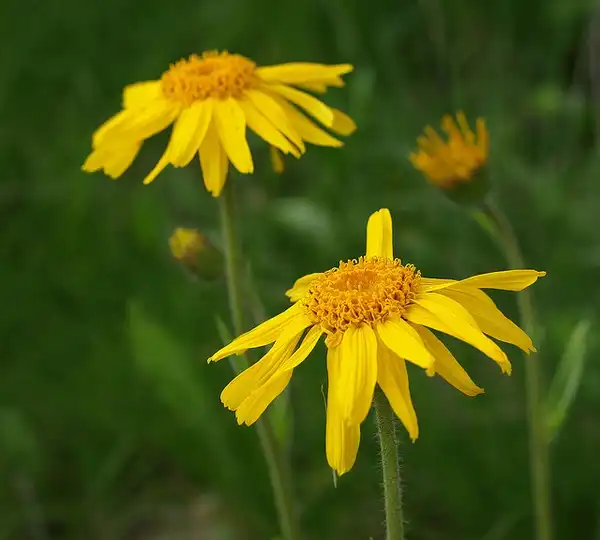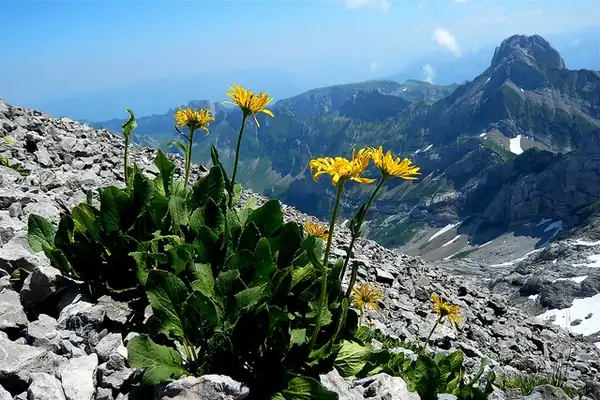
• Photo of Arnica montana (Arnica montanas)

Plant Profile: Arnica montana

Taxonomy: Arnica montana

Names

Arnica Root, Leopard's-Bane, Mountain Snuff, Mountain Tobacco

  • Photo of Arnica montana (Arnica montanas)

Phonetic Spelling:AR-nih-kah mon-TAY-nah

Genus:Arnica

Species:montana

Family:Asteraceae

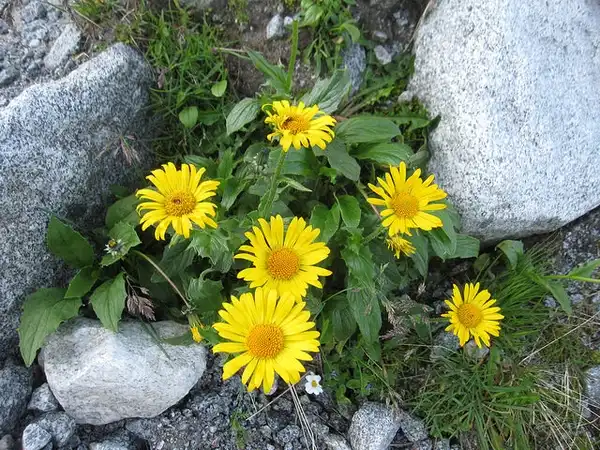
Leopard's Bane is a perennial herb belonging to the aster family, originally found in Europe. This plant typically reaches heights of 0.5 to 2 feet and features soft, basal leaves. Its flowering period spans from May to August, showcasing vibrant yellow-orange ray flowers that encircle yellow disc florets, which are later followed by achenes.

This herb thrives in a variety of well-drained soils, whether in full sun or partial shade, although it favors slightly alkaline, moist sandy loams. However, it does not withstand drought conditions well.

Arnica montana Feature Summary

Arnica montana Image Gallery

Tags

#yellow
#poisonous
#perennial
#yellow flowers
#rock gardens
#borders
#bedding plants

Similar Plants

Arnica montana is often confused with:

Arnica montana Feature Summary

Attributes
Flowers
Flowers are yellow rays surrounding yellow disc florets in late spring to early summer.
Gold/Yellow
Spring
Summer
Leaves
While basal leaves are clustered, the stem leaves are opposite and simple.
Poisonous to Humans
Poisonous through dermatitis and ingestion; Poisonous parts: roots and flowers. Symptoms may include: Skin irritation upon contact; after ingestion, heart palpitation, vomiting, drowsiness, shortness of breath, and coma in children.
Flowers
Roots
Whole Plant Traits
Herbaceous Perennial
Poisonous
Cultural Conditions
Full sun (6 or more hours of direct sunlight a day)
Partial Shade (Direct sunlight only part of the day, 2-6 hours)
Alkaline (>8.0)
Neutral (6.0-8.0)
Good Drainage
Moist
4a
4b
5b
5a
6a
6b
7a
7b
8b
8a
9a
9b
Clay
Loam (Silt)
Sand
Fruit
Landscape
Rock Garden
Poisonous to Humans
Contact Dermatitis
Problem for Children

Arnica montana Attributes

Arnica montana: Uses (Ethnobotany)

Used in herbal medicine for centuries.
Arnica montana: Country Or Region Of Origin

Europe

Arnica montana: Recommended Propagation Strategy

Division
Grafting
Layering
Leaf Cutting
Root Cutting
Seed
Stem Cutting

Arnica montana Flowers

Arnica montana: Flower Description

Flowers are yellow rays surrounding yellow disc florets in late spring to early summer.

Arnica montana: Flower Color

filter_vintage
Gold/Yellow

Arnica montana: Flower Inflorescence

Catkin
Corymb
Cyme
Head
Insignificant
Panicle
Raceme
Solitary
Spadix
Spike
Umbel

Arnica montana: Flower Bloom Time

Winter
Spring
Summer
Fall

Arnica montana: Flower Shape

Bell
Cross
Crown
Cup
Dome
Funnel
Irregular
Lipped
Radial
Saucer
Star
Trumpet
Tubular
Urn
Wheel

Arnica montana Leaves

Arnica montana: Leaf Description

While basal leaves are clustered, the stem leaves are opposite and simple.

Arnica montana: Woody Plant Leaf Characteristics

Broadleaf Evergreen
Deciduous
Needled Evergreen
Semi-evergreen

Arnica montana: Leaf Type

Compound (Pinnately , Bipinnately, Palmately)
Fronds
Needles
Sheath
Simple

Arnica montana: Leaf Arrangement

Alternate
Opposite
Other/more complex
Rosulate
Whorled

Arnica montana: Hairs Present

No
Yes

Arnica montana Poisonous to Humans

Arnica montana: Poison Symptoms

Poisonous through dermatitis and ingestion; Poisonous parts: roots and flowers. Symptoms may include: Skin irritation upon contact; after ingestion, heart palpitation, vomiting, drowsiness, shortness of breath, and coma in children.

Arnica montana: Poison Toxic Principle

Helenalin

Arnica montana: Poison Severity

High
Low
Medium

Arnica montana: Causes Contact Dermatitis

No
Yes

Arnica montana: Poison Part

Bark
Flowers
Fruits
Leaves
Roots
Sap/Juice
Seeds
Stems

Arnica montana Whole Plant Traits

Arnica montana: Plant Type

Annual
Bulb
Carnivorous
Edible
Epiphyte
Fern
Ground Cover
Herb
Herbaceous Perennial
Houseplant
Mushroom
Native Plant
Ornamental Grasses and Sedges
Perennial
Poisonous
Rose
Shrub
Succulent
Tree
Turfgrass
Vegetable
Vine
Water Plant
Weed
Wildflower

Arnica montana: Woody Plant Leaf Characteristics

Broadleaf Evergreen
Deciduous
Needled Evergreen
Semi-evergreen

Arnica montana Cultural Conditions

Arnica montana: Light

Dappled Sunlight (Shade through upper canopy all day)
Deep shade (Less than 2 hours to no direct sunlight)
Full sun (6 or more hours of direct sunlight a day)
Partial Shade (Direct sunlight only part of the day, 2-6 hours)

Arnica montana: Soil pH

Acid (<6.0)
Alkaline (>8.0)
Neutral (6.0-8.0)

Arnica montana: Soil Drainage

Frequent Standing Water
Good Drainage
Moist
Occasional Flooding
Occasionally Dry
Occasionally Wet
Very Dry

Arnica montana: USDA Plant Hardiness Zone

thermostat
4a
thermostat
4b
thermostat
5a
thermostat
5b
thermostat
6a
thermostat
6b
thermostat
7a
thermostat
7b
thermostat
8a
thermostat
8b
thermostat
9a
thermostat
9b

Arnica montana: Soil Texture

Clay
High Organic Matter
Loam (Silt)
Sand
Shallow Rocky

Arnica montana Fruit

Arnica montana: Fruit Type

Achene
Aggregate
Berry
Capsule
Caryopsis
Drupe
Follicle
Legume
Nut
Pome
Samara
Schizocarp
Siliqua

Arnica montana Stem

Arnica montana: Stem Is Aromatic

No
Yes

Arnica montana Landscape

Arnica montana: Landscape Theme

Asian Garden
Butterfly Garden
Children's Garden
Cottage Garden
Cutting Garden
Drought Tolerant Garden
Edible Garden
English Garden
Fairy Garden
Garden for the Blind
Native Garden
Nighttime Garden
Pollinator Garden
Rain Garden
Rock Garden
Shade Garden
Water Garden
Winter Garden

Arnica montana: Design Feature

Accent
Barrier
Border
Flowering Tree
Foundation Planting
Hedge
Mass Planting
Screen/Privacy
Security
Shade Tree
Small groups
Small Tree
Specimen
Street Tree
Understory Tree

Arnica montana: Problems

Allelopathic
Contact Dermatitis
Frequent Disease Problems
Frequent Insect Problems
Invasive Species
Malodorous
Messy
Poisonous to Humans
Problem for Cats
Problem for Children
Problem for Dogs
Problem for Horses
Short-lived
Spines/Thorns
Weak Wood
Weedy