Plant Profile: Hypoxis hirsuta

Taxonomy: Hypoxis hirsuta

Names

Common Goldstar, Common Stargrass, Eastern Yellow Star-grass, Yellow Star-grass

  • Photo of Hypoxis hirsuta (Hypoxis hirsutas)

Phonetic Spelling:hy-POK-sis her-SOO-tuh

Genus:Hypoxis

Species:hirsuta

Family:Hypoxidaceae

Common Goldstar is a compact, tufted plant resembling grass, which emerges from a tough, hairy corm. This plant thrives in a variety of environments, including open woodlands, neglected fields, lawns, prairies, and other unshaded spaces. While it is not particularly invasive, it has the potential to establish colonies over time.

The plant's grass-like appearance becomes distinguishable primarily during its flowering phase.

The blooms attract various pollinators, including carpenter bees, mason bees, and halictid bees, while some flies and beetles also feed on the pollen. Additionally, small rodents may consume the corms.

In terms of challenges, the seeds are quite small and can be difficult to gather.

For further details on Hypoxis, additional resources are available.

Hypoxis hirsuta Feature Summary

Hypoxis hirsuta Image Gallery

Tags

#yellow flowers
#spring flowers
#moist soil
#grass-like
#pollinator plant
#native wildflower
#food source summer
#food source nectar
#food source pollen
#Piedmont Mountains FAC
#Coastal FACW
#native
#dry soils tolerant
#bee friendly
#audubon
#woodlands

Similar Plants

Hypoxis hirsuta Feature Summary

Attributes
AL, AR, CO, CT, DC, DE, FL, GA, IA, IL, IN, KS, KY, LA, MA, MD, ME, MI, MN, MO, MS, NC, ND, NE, NH, NJ, NM, NY, OH, OK, PA, RI, SC, SD, TN, TX, VA, VT, WI, WV
Attracts bees, butterflies and other pollinators.
Perennial
Wildlife Food Source
Attracts Pollinators
Fruit
Displays from May to July.
Flowers
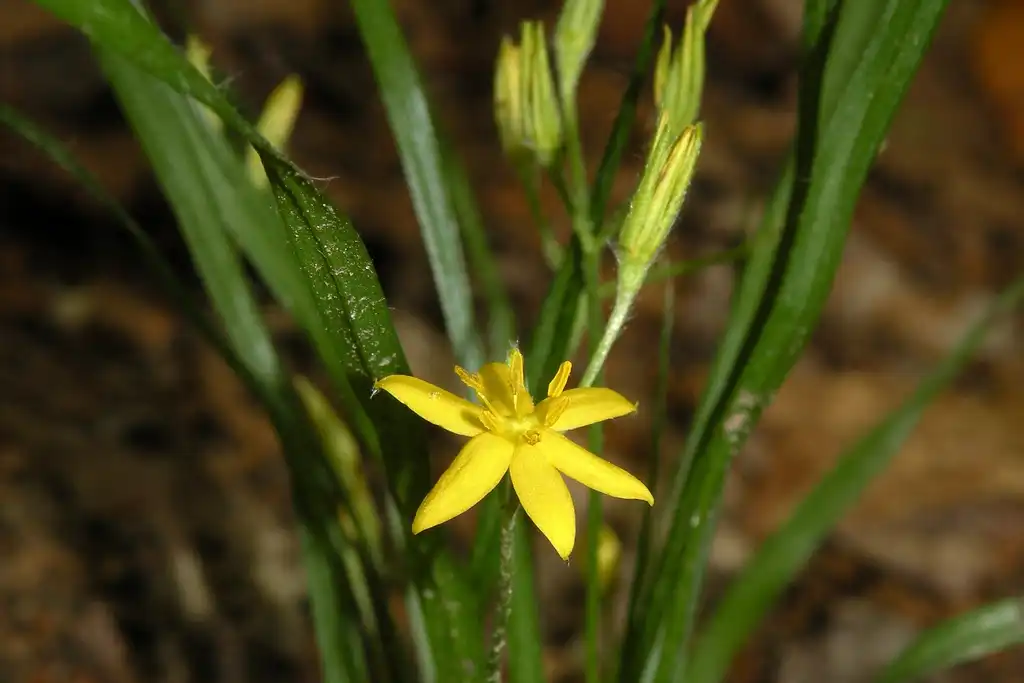
A loose cluster of yellow one to three star-shaped flower buds. The 3/4" flowers bloom with six, pointed petals. Bloom from March to June. The center contains a yellow pistil surrounded by 6 stamens with yellow anthers.
Gold/Yellow
Spring
Summer
6 petals/rays
< 1 inch
Leaves
12" tall hairy, narrow grasslike leaves that originate from the base of the plant. The leaves are linear or linear-elliptic in shape.
Elliptical
Linear
> 6 inches
< 1 inch
Stem
The 8" stems can be erect or reclining. Each stem will end in a loose umbel of 1 or 2 flowers.
Straight
Whole Plant Traits
Perennial
Wildflower
Cultural Conditions
Full sun (6 or more hours of direct sunlight a day)
Partial Shade (Direct sunlight only part of the day, 2-6 hours)
Deep shade (Less than 2 hours to no direct sunlight)
Good Drainage
Occasionally Dry
Coastal
Mountains
Piedmont
Loam (Silt)
Sand
Shallow Rocky
Landscape
Pollinator Garden
Native Garden
Woodland
Meadow
Pollinators
Bees

Hypoxis hirsuta Attributes

Hypoxis hirsuta: Distribution

AL, AR, CO, CT, DC, DE, FL, GA, IA, IL, IN, KS, KY, LA, MA, MD, ME, MI, MN, MO, MS, NC, ND, NE, NH, NJ, NM, NY, OH, OK, PA, RI, SC, SD, TN, TX, VA, VT, WI, WV

Hypoxis hirsuta: Wildlife Value

Attracts bees, butterflies and other pollinators.

Hypoxis hirsuta: Life Cycle

Annual
Biennial
Bulb
Perennial
Woody

Hypoxis hirsuta: Recommended Propagation Strategy

Division
Grafting
Layering
Leaf Cutting
Root Cutting
Seed
Stem Cutting

Hypoxis hirsuta: Play Value

Attractive Flowers
Attracts Pollinators
Buffer
Colorful
Defines Paths
Easy to Grow
Edible fruit
Fragrance
Pieces Used in Games
Screening
Shade
Sound
Textural
Wildlife Cover/Habitat
Wildlife Food Source
Wildlife Larval Host
Wildlife Nesting
Wind Break
Wind Shimmer

Hypoxis hirsuta Fruit

Hypoxis hirsuta: Fruit Description

Displays from May to July.

Hypoxis hirsuta: Display/Harvest Time

Fall
Spring
Summer
Winter

Hypoxis hirsuta Flowers

Hypoxis hirsuta: Flower Description

A loose cluster of yellow one to three star-shaped flower buds. The 3/4" flowers bloom with six, pointed petals. Bloom from March to June. The center contains a yellow pistil surrounded by 6 stamens with yellow anthers.

Hypoxis hirsuta: Flower Color

filter_vintage
Gold/Yellow

Hypoxis hirsuta: Flower Value To Gardener

Edible
Fragrant
Good Cut
Good Dried
Long Bloom Season
Long-lasting
Showy

Hypoxis hirsuta: Flower Bloom Time

Winter
Spring
Summer
Fall

Hypoxis hirsuta: Flower Petals

2-3 rays/petals
4-5 petals/rays
6 petals/rays
7 - 20 petals/rays
asymmetrical petals
Bracts
Colored Sepals
fused petals
more than 20 petals/rays
Tepals

Hypoxis hirsuta: Flower Shape

Bell
Cross
Crown
Cup
Dome
Funnel
Irregular
Lipped
Radial
Saucer
Star
Trumpet
Tubular
Urn
Wheel

Hypoxis hirsuta: Flower Size

1-3 inches
3-6 inches
< 1 inch
> 6 inches

Hypoxis hirsuta Leaves

Hypoxis hirsuta: Leaf Description

12" tall hairy, narrow grasslike leaves that originate from the base of the plant. The leaves are linear or linear-elliptic in shape.

Hypoxis hirsuta: Leaf Color

spa
Green

Hypoxis hirsuta: Leaf Type

Compound (Pinnately , Bipinnately, Palmately)
Fronds
Needles
Sheath
Simple

Hypoxis hirsuta: Leaf Shape

Acicular
Auriculate
Cordate
Cuneate
Deltoid
Elliptical
Filiform
Lanceolate
Linear
Oblanceolate
Oblong
Obovate
Obtuse
Orbicular
Ovate
Palmasect
Palmatifid
Peltate
Pinnatifid
Pinnatisect
Reniform
Rhomboidal
Spatulate
Subcordate
Subulate

Hypoxis hirsuta: Leaf Margin

Crenate
Crenulate
Dentate
Denticulate
Doubly Crenate
Doubly Dentate
Doubly Serrate
Entire
Lobed
Serrate
Sinuate
Undulate

Hypoxis hirsuta: Hairs Present

No
Yes

Hypoxis hirsuta: Leaf Length

< 1 inch
1-3 inches
3-6 inches
> 6 inches

Hypoxis hirsuta: Leaf Width

< 1 inch
1-3 inches
3-6 inches
> 6 inches

Hypoxis hirsuta Stem

Hypoxis hirsuta: Stem Description

The 8" stems can be erect or reclining. Each stem will end in a loose umbel of 1 or 2 flowers.

Hypoxis hirsuta: Stem Is Aromatic

No
Yes

Hypoxis hirsuta: Stem Form

Straight
Zig Zags

Hypoxis hirsuta Whole Plant Traits

Hypoxis hirsuta: Plant Type

Annual
Bulb
Carnivorous
Edible
Epiphyte
Fern
Ground Cover
Herb
Herbaceous Perennial
Houseplant
Mushroom
Native Plant
Ornamental Grasses and Sedges
Perennial
Poisonous
Rose
Shrub
Succulent
Tree
Turfgrass
Vegetable
Vine
Water Plant
Weed
Wildflower

Hypoxis hirsuta Cultural Conditions

Hypoxis hirsuta: Light

Dappled Sunlight (Shade through upper canopy all day)
Deep shade (Less than 2 hours to no direct sunlight)
Full sun (6 or more hours of direct sunlight a day)
Partial Shade (Direct sunlight only part of the day, 2-6 hours)

Hypoxis hirsuta: Soil Drainage

Frequent Standing Water
Good Drainage
Moist
Occasional Flooding
Occasionally Dry
Occasionally Wet
Very Dry

Hypoxis hirsuta: NC Region

Coastal
Mountains
Piedmont

Hypoxis hirsuta: Soil Texture

Clay
High Organic Matter
Loam (Silt)
Sand
Shallow Rocky

Hypoxis hirsuta Landscape

Hypoxis hirsuta: Landscape Theme

Asian Garden
Butterfly Garden
Children's Garden
Cottage Garden
Cutting Garden
Drought Tolerant Garden
Edible Garden
English Garden
Fairy Garden
Garden for the Blind
Native Garden
Nighttime Garden
Pollinator Garden
Rain Garden
Rock Garden
Shade Garden
Water Garden
Winter Garden

Hypoxis hirsuta: Landscape Location

Coastal
Container
Hanging Baskets
Houseplants
Lawn
Meadow
Naturalized Area
Near Septic
Patio
Pond
Pool/Hardscape
Recreational Play Area
Riparian
Rock Wall
Slope/Bank
Small Space
Vertical Spaces
Walkways
Woodland

Hypoxis hirsuta: Attracts

Bats
Bees
Butterflies
Frogs
Hummingbirds
Moths
Pollinators
Predatory Insects
Reptiles
Small Mammals
Songbirds
Specialized Bees