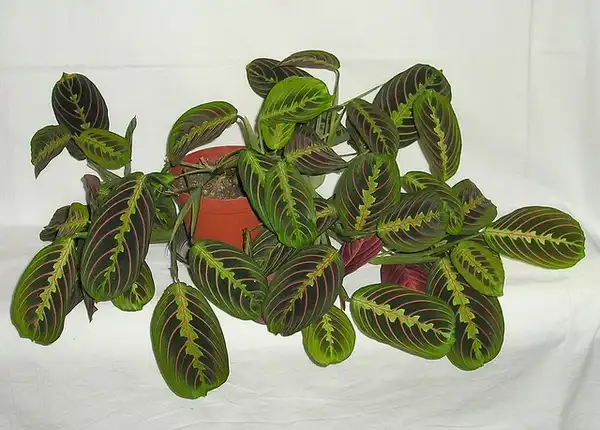
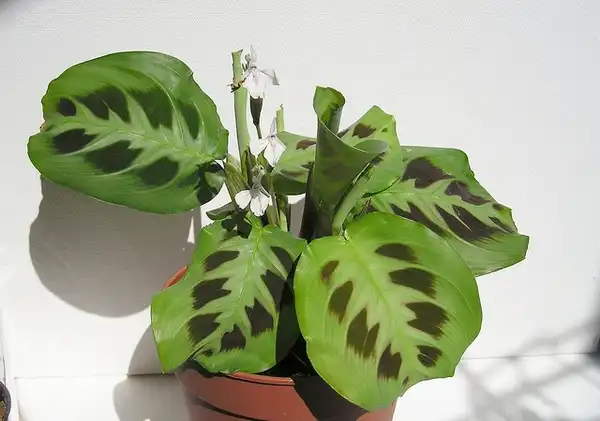
• Photo of Maranta leuconeura (Maranta leuconeuras)

Plant Profile: Maranta leuconeura

Names

Cathedral Windows, Herringbone Plant, Prayer Plant, Rabbit Tracks, Red-Veined Prayer Plant

  • Photo of Maranta leuconeura (Maranta leuconeuras)

Phonetic Spelling:muh-RAN-tuh loo-koh-NUR-uh

Genus:Maranta

Species:leuconeura

Family:

The Prayer Plant is a perennial tropical species often cultivated as a houseplant in temperate regions. It features striking, variegated ovate leaves with smooth edges that fold at night, mimicking the posture of hands in prayer. The underside of the leaves displays a blend of gray-green and purple-green hues, while new leaves emerge in a rolled formation. For optimal growth, position the plant in bright, indirect light, as excessive sunlight can fade its vibrant colors. During the growing season, maintain consistently moist potting soil, but allow it to dry out during the winter months. This plant thrives in humid environments, so consider placing it in a room with high humidity or setting the pot on a tray filled with wet pebbles.

While the Prayer Plant can produce blooms under ideal conditions, the flowers are small and not particularly striking; its primary appeal lies in its unique foliage. The plant is distinguished by its prominent red fishbone-patterned veins, light central variegation, and pale undersides. During the day, the leaves are held parallel to the ground, transitioning to a vertical 'prayer' position at night. In low light or poor nutrient conditions, the colors of the leaves may diminish. This plant is frequently used in interior design, often seen in hanging baskets or as ground cover in indoor landscapes. It can tolerate low to medium light but is sensitive to direct sunlight and low humidity levels. Additionally, it does not fare well in cold temperatures or drafts, and excessive fluoride or over-fertilization can lead to leaf burn. Fortunately, the Prayer Plant is generally free from significant pest or disease issues.

In terms of pests and diseases, while there are no major concerns, it may occasionally attract spider mites and mealybugs. Root rot can occur if the soil does not drain properly.

**Quick Identification Tips:**

Maranta leuconeura Feature Summary

Maranta leuconeura Image Gallery

Tags

#evergreen
#houseplant
#showy leaves
#interiorscape
#variegated leaves
#fantz

Similar Plants

Maranta leuconeura is often confused with:

Maranta leuconeura Feature Summary

Flowers
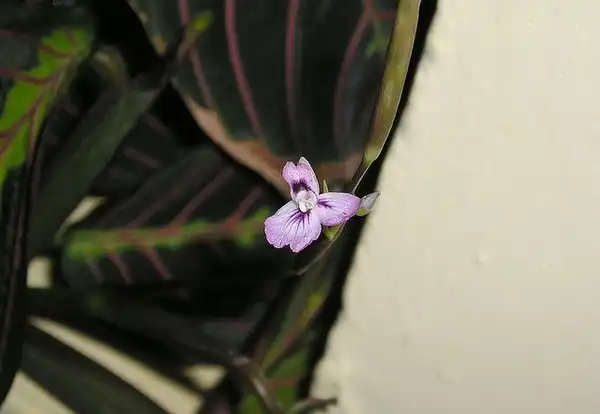
Rarely flowers indoors but flowers are small, have 2-5 petals, are white to purple or spotted purple, zygomorphic, two-lipped and appear on slender stalks. The corolla tube is green, sepals are thing, bracts are persistent and papery, and staminodes are petaloid. Inflorescence is a stalked panicle on axillary.
Purple/Lavender
White
4-5 petals/rays
2-3 rays/petals
< 1 inch
Leaves
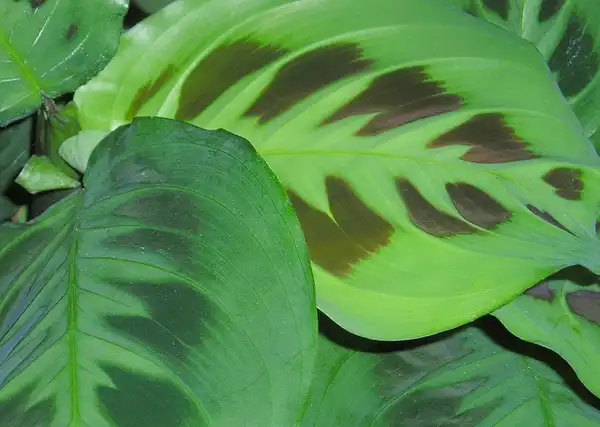
Leaves are alternate, crowded, simple, oblong-elliptic, have an apex truncate with a short sharp acumen, have a rotund base, are entire, have an upperside that is medium to dark green and variegated with pale green to yellow markings at the midrib, have central and main veins that are prominent in a fishbone pattern and are colored red, have pale green margins, and have an underside that is reddish to burgundy in color. Leaves exhibit sleep movement and are erect at night. They also have a long, sheathing petiole.
Green
White
Gold/Yellow
Variegated
Purple/Lavender
Elliptical
Oblong
Stem
Stems are short and rhizomatous.
Whole Plant Traits
Perennial
Cultural Conditions
Dappled Sunlight (Shade through upper canopy all day)
12 inches-3 feet
Less than 12 inches
Landscape
Container
Houseplants

Maranta leuconeura Attributes

Maranta leuconeura: Country Or Region Of Origin

Brazil
Maranta leuconeura: Recommended Propagation Strategy

Division
Grafting
Layering
Leaf Cutting
Root Cutting
Seed
Stem Cutting

Maranta leuconeura Flowers

Maranta leuconeura: Flower Description

Rarely flowers indoors but flowers are small, have 2-5 petals, are white to purple or spotted purple, zygomorphic, two-lipped and appear on slender stalks. The corolla tube is green, sepals are thing, bracts are persistent and papery, and staminodes are petaloid. Inflorescence is a stalked panicle on axillary.

Maranta leuconeura: Flower Color

filter_vintage
Purple/Lavender
filter_vintage
White

Maranta leuconeura: Flower Inflorescence

Catkin
Corymb
Cyme
Head
Insignificant
Panicle
Raceme
Solitary
Spadix
Spike
Umbel

Maranta leuconeura: Flower Petals

2-3 rays/petals
4-5 petals/rays
6 petals/rays
7 - 20 petals/rays
asymmetrical petals
Bracts
Colored Sepals
fused petals
more than 20 petals/rays
Tepals

Maranta leuconeura: Flower Shape

Bell
Cross
Crown
Cup
Dome
Funnel
Irregular
Lipped
Radial
Saucer
Star
Trumpet
Tubular
Urn
Wheel

Maranta leuconeura: Flower Size

1-3 inches
3-6 inches
< 1 inch
> 6 inches

Maranta leuconeura Leaves

Maranta leuconeura: Leaf Description

Leaves are alternate, crowded, simple, oblong-elliptic, have an apex truncate with a short sharp acumen, have a rotund base, are entire, have an upperside that is medium to dark green and variegated with pale green to yellow markings at the midrib, have central and main veins that are prominent in a fishbone pattern and are colored red, have pale green margins, and have an underside that is reddish to burgundy in color. Leaves exhibit sleep movement and are erect at night. They also have a long, sheathing petiole.

Maranta leuconeura: Leaf Color

spa
Gold/Yellow
spa
Green
spa
Purple/Lavender
spa
Variegated
spa
White

Maranta leuconeura: Leaf Arrangement

Alternate
Opposite
Other/more complex
Rosulate
Whorled

Maranta leuconeura: Leaf Shape

Acicular
Auriculate
Cordate
Cuneate
Deltoid
Elliptical
Filiform
Lanceolate
Linear
Oblanceolate
Oblong
Obovate
Obtuse
Orbicular
Ovate
Palmasect
Palmatifid
Peltate
Pinnatifid
Pinnatisect
Reniform
Rhomboidal
Spatulate
Subcordate
Subulate

Maranta leuconeura: Leaf Margin

Crenate
Crenulate
Dentate
Denticulate
Doubly Crenate
Doubly Dentate
Doubly Serrate
Entire
Lobed
Serrate
Sinuate
Undulate

Maranta leuconeura: Hairs Present

No
Yes

Maranta leuconeura: Leaf Value To Gardener

Edible
Fragrant
Good Cut
Good Dried
Long-lasting
Showy

Maranta leuconeura Stem

Maranta leuconeura: Stem Description

Stems are short and rhizomatous.

Maranta leuconeura: Stem Is Aromatic

No
Yes

Maranta leuconeura Whole Plant Traits

Maranta leuconeura: Plant Type

Annual
Bulb
Carnivorous
Edible
Epiphyte
Fern
Ground Cover
Herb
Herbaceous Perennial
Houseplant
Mushroom
Native Plant
Ornamental Grasses and Sedges
Perennial
Poisonous
Rose
Shrub
Succulent
Tree
Turfgrass
Vegetable
Vine
Water Plant
Weed
Wildflower

Maranta leuconeura Cultural Conditions

Maranta leuconeura: Light

Dappled Sunlight (Shade through upper canopy all day)
Deep shade (Less than 2 hours to no direct sunlight)
Full sun (6 or more hours of direct sunlight a day)
Partial Shade (Direct sunlight only part of the day, 2-6 hours)

Maranta leuconeura: Available Space To Plant

12 inches-3 feet
12-24 feet
24-60 feet
3 feet-6 feet
6-feet-12 feet
Less than 12 inches
more than 60 feet

Maranta leuconeura: USDA Plant Hardiness Zone

thermostat
11a
thermostat
11b

Maranta leuconeura Landscape

Maranta leuconeura: Resistance To Challenges

Black Walnut
Compaction
Deer
Diseases
Drought
Dry Soil
Erosion
Fire
Foot Traffic
Heat
Heavy Shade
Humidity
Insect Pests
Pollution
Poor Soil
Rabbits
Salt
Slugs
Squirrels
Storm damage
Urban Conditions
Voles
Wet Soil
Wind

Maranta leuconeura: Landscape Location

Coastal
Container
Hanging Baskets
Houseplants
Lawn
Meadow
Naturalized Area
Near Septic
Patio
Pond
Pool/Hardscape
Recreational Play Area
Riparian
Rock Wall
Slope/Bank
Small Space
Vertical Spaces
Walkways
Woodland