Plant Profile: Nicotiana glauca

Taxonomy: Nicotiana glauca

Names

Mustard Tree, Nicotiana, Tobacco, Tree Tobacco

  • Photo of Nicotiana glauca (Nicotiana glaucas)

Phonetic Spelling:nih-koh-tee-AY-nah GLAW-kah

Genus:Nicotiana

Species:glauca

Family:Solanaceae

Nicotiana glauca, commonly referred to as Tree Tobacco, is a type of wild tobacco characterized by its slender, multi-branched structure, resembling a small tree or shrub. This species thrives in warm temperate zones, arid climates, and subtropical regions, often found flourishing along roadsides and riverbanks. Notably drought-resistant, it can adapt to a variety of environmental conditions, frequently outcompeting local flora. Tree Tobacco tends to establish dense, single-species populations and poses a toxicity risk to livestock. Its invasive nature has led to concerns in numerous areas worldwide, including California.

Every part of this plant is highly toxic.

Nicotiana glauca Feature Summary

Nicotiana glauca Image Gallery

Tags

#small tree
#poisonous
#shrub
#weedy
#warm climates
#problem for cats
#problem for dogs
#problem for horses

Similar Plants

Nicotiana glauca Feature Summary

Attributes
Use medicinally by native cultures
AL, AZ, CA, FL, GA, HI, MD, NJ, NM, NV, OH, TX
Perennial
Woody
Fruit
Egg-shaped, two-valved capsule, 0.5- 0.75 inches long and slightly longer than the persistent papery calyx. It produces a large number of tiny seeds, which can be dispersed by wind and water.
Flowers
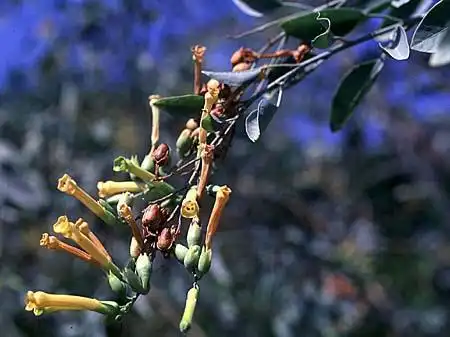
Flowers tubular, cream or yellow-green, 5-lobed at top
Gold/Yellow
Green
Cream/Tan
4-5 petals/rays
Leaves
Leaves are on stalks, alternate, smooth, succulent with a thick epicuticular waxy layer.
Green
Gray/Silver
Fleshy
Waxy
Poisonous to Humans
HIGHLY TOXIC, MAY BE FATAL IF EATEN! Vomiting, diarrhea, slow pulse, dizziness, collapse, paralysis, depression, death, and respiratory failure can occur if eaten.
Nicotine, a toxic alkaloid
Leaves
Flowers
Whole Plant Traits
Shrub
Tree
Poisonous
Multi-stemmed
Cultural Conditions
Full sun (6 or more hours of direct sunlight a day)
Partial Shade (Direct sunlight only part of the day, 2-6 hours)
Landscape
Poisonous to Humans
Problem for Cats
Problem for Dogs
Problem for Horses
Weedy

Nicotiana glauca Attributes

Nicotiana glauca: Uses (Ethnobotany)

Use medicinally by native cultures
Nicotiana glauca: Country Or Region Of Origin

South America

Nicotiana glauca: Distribution

AL, AZ, CA, FL, GA, HI, MD, NJ, NM, NV, OH, TX

Nicotiana glauca: Life Cycle

Annual
Biennial
Bulb
Perennial
Woody

Nicotiana glauca: Recommended Propagation Strategy

Division
Grafting
Layering
Leaf Cutting
Root Cutting
Seed
Stem Cutting

Nicotiana glauca Fruit

Nicotiana glauca: Fruit Description

Egg-shaped, two-valved capsule, 0.5- 0.75 inches long and slightly longer than the persistent papery calyx. It produces a large number of tiny seeds, which can be dispersed by wind and water.

Nicotiana glauca: Fruit Type

Achene
Aggregate
Berry
Capsule
Caryopsis
Drupe
Follicle
Legume
Nut
Pome
Samara
Schizocarp
Siliqua

Nicotiana glauca: Fruit Length

< 1 inch
1-3 inches
> 3 inches

Nicotiana glauca Flowers

Nicotiana glauca: Flower Description

Flowers tubular, cream or yellow-green, 5-lobed at top

Nicotiana glauca: Flower Color

filter_vintage
Cream/Tan
filter_vintage
Gold/Yellow
filter_vintage
Green

Nicotiana glauca: Flower Inflorescence

Catkin
Corymb
Cyme
Head
Insignificant
Panicle
Raceme
Solitary
Spadix
Spike
Umbel

Nicotiana glauca: Flower Petals

2-3 rays/petals
4-5 petals/rays
6 petals/rays
7 - 20 petals/rays
asymmetrical petals
Bracts
Colored Sepals
fused petals
more than 20 petals/rays
Tepals

Nicotiana glauca: Flower Shape

Bell
Cross
Crown
Cup
Dome
Funnel
Irregular
Lipped
Radial
Saucer
Star
Trumpet
Tubular
Urn
Wheel

Nicotiana glauca Leaves

Nicotiana glauca: Leaf Description

Leaves are on stalks, alternate, smooth, succulent with a thick epicuticular waxy layer.

Nicotiana glauca: Leaf Color

spa
Gray/Silver
spa
Green

Nicotiana glauca: Leaf Type

Compound (Pinnately , Bipinnately, Palmately)
Fronds
Needles
Sheath
Simple

Nicotiana glauca: Leaf Arrangement

Alternate
Opposite
Other/more complex
Rosulate
Whorled

Nicotiana glauca: Hairs Present

No
Yes

Nicotiana glauca: Leaf Feel

Fleshy
Glossy
Leathery
Papery
Prickly
Rough
Rubbery
Slippery
Smooth
Soft
Velvety
Waxy

Nicotiana glauca Poisonous to Humans

Nicotiana glauca: Poison Symptoms

HIGHLY TOXIC, MAY BE FATAL IF EATEN! Vomiting, diarrhea, slow pulse, dizziness, collapse, paralysis, depression, death, and respiratory failure can occur if eaten.

Nicotiana glauca: Poison Toxic Principle

Nicotine, a toxic alkaloid

Nicotiana glauca: Poison Severity

High
Low
Medium

Nicotiana glauca: Causes Contact Dermatitis

No
Yes

Nicotiana glauca: Poison Part

Bark
Flowers
Fruits
Leaves
Roots
Sap/Juice
Seeds
Stems

Nicotiana glauca Whole Plant Traits

Nicotiana glauca: Plant Type

Annual
Bulb
Carnivorous
Edible
Epiphyte
Fern
Ground Cover
Herb
Herbaceous Perennial
Houseplant
Mushroom
Native Plant
Ornamental Grasses and Sedges
Perennial
Poisonous
Rose
Shrub
Succulent
Tree
Turfgrass
Vegetable
Vine
Water Plant
Weed
Wildflower

Nicotiana glauca: Habit/Form

Arching
Ascending
Broad
Cascading
Climbing
Clumping
Columnar
Conical
Creeping
Dense
Erect
Horizontal
Irregular
Mounding
Multi-stemmed
Multi-trunked
Open
Oval
Prostrate
Pyramidal
Rounded
Spreading
Vase
Weeping

Nicotiana glauca: Growth Rate

Slow
Medium
Rapid

Nicotiana glauca Cultural Conditions

Nicotiana glauca: Light

Dappled Sunlight (Shade through upper canopy all day)
Deep shade (Less than 2 hours to no direct sunlight)
Full sun (6 or more hours of direct sunlight a day)
Partial Shade (Direct sunlight only part of the day, 2-6 hours)

Nicotiana glauca Stem

Nicotiana glauca: Stem Is Aromatic

No
Yes

Nicotiana glauca Landscape

Nicotiana glauca: Problems

Allelopathic
Contact Dermatitis
Frequent Disease Problems
Frequent Insect Problems
Invasive Species
Malodorous
Messy
Poisonous to Humans
Problem for Cats
Problem for Children
Problem for Dogs
Problem for Horses
Short-lived
Spines/Thorns
Weak Wood
Weedy