Calanthe 'Kozu Spice': Uses (Ethnobotany)
Orchid rhizomes can be ground into a powder called salep and used as flour. The flowers can be used as a garnish, generally on salads. Some cultures consider orchid bulbs an aphrodisiac.
Phonetic Spelling:
Genus:Calanthe
Species:
Family:Orchidaceae
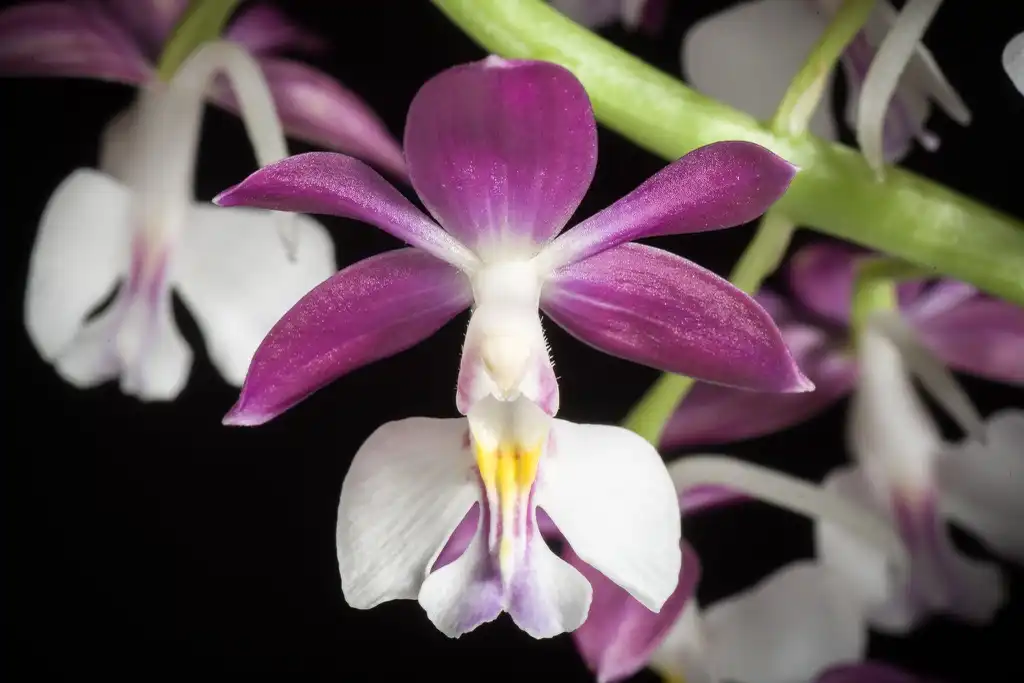
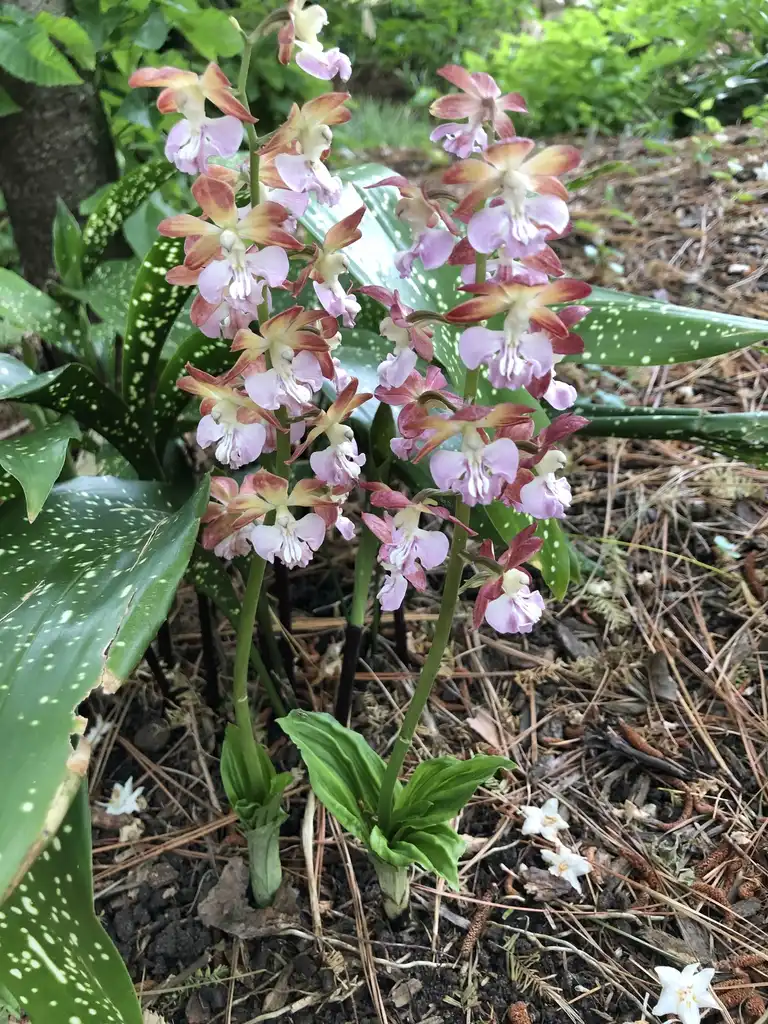
Calanthe 'Kozu Spice', commonly referred to as the Kozu Spice orchid, is an evergreen to semi-evergreen orchid characterized by its striking two-toned flowers, which can be found in vibrant combinations of red and yellow, red and white, or pink and red. This cultivar belongs to the Orchidaceae family and is a primary hybrid, resulting from the cross between the seed parent Calanthe discolor and the pollen parent Calanthe izu-insularis. Developed by K. Karasawa in 1996, 'Kozu Spice' has a lineage that includes the now nearly extinct Calanthe izu-insularis, which is indigenous to Japan's Izu Islands, alongside the more abundant Calanthe discolor. The name Calanthe derives from the Greek words “Kalos,” meaning beautiful, and “Anthos,” meaning flower.
This orchid thrives as a perennial in USDA hardiness zones 7a to 9b, and with adequate winter protection, it can endure conditions as low as zone 6. Its foliage may exhibit a slight fuzziness, a trait inherited from both parent species. In most winters, 'Kozu Spice' remains evergreen, although its leaves may appear tattered in the spring. It pairs well with hostas, trilliums, and ferns in moist, semi-shaded environments. For optimal growth, it is advisable to blend native soil with ample compost, peat, and sand to create a well-draining, airy mix that retains moisture. Fertilization is typically unnecessary unless a soil test suggests otherwise. When planting, spread the roots apart and position the crown level with or slightly below the soil surface, taking care not to bury it too deeply to avoid crown rot. Water thoroughly from April to September and apply a 2 to 4-inch layer of mulch after the first frost. In regions colder than zone 7b, it may be feasible to leave the plant in the garden over winter by covering it with a thick layer of leaves, up to 10 inches deep. Outdoors, the plant favors shaded areas and can thrive in full shade.
Healthy specimens can grow into a clump measuring up to 12 inches, which can be divided and transplanted from winter through early spring. If grown in a container, it should be moved indoors to a cool area during winter to prevent freezing. During spring cleanup, it is best to allow any damaged leaves from winter to decompose naturally to protect against viruses. After flowering, deadheading is recommended to prevent seed formation, which can hinder future blooms. The pollination mechanisms of Calanthe remain largely unexplored, but studies suggest that C. izu-insularis and C. discolor may be pollinated by small solitary bees, such as sweat bees. Although these orchids do not produce nectar, they attract pollinators through deceptive strategies.
Regarding plant health, there are no known issues with diseases or insects. It is advisable to avoid removing old leaves, as this may increase the risk of viral infections; allowing them to die off naturally is the preferred approach.
Calanthe 'Kozu Spice' Feature Summary
Calanthe 'Kozu Spice' Image Gallery