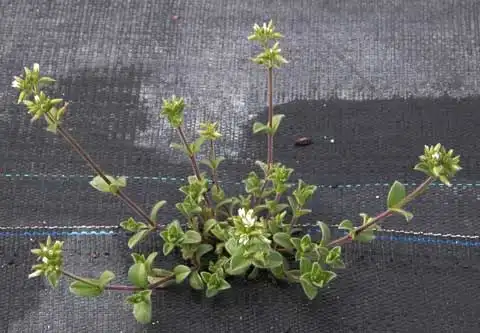
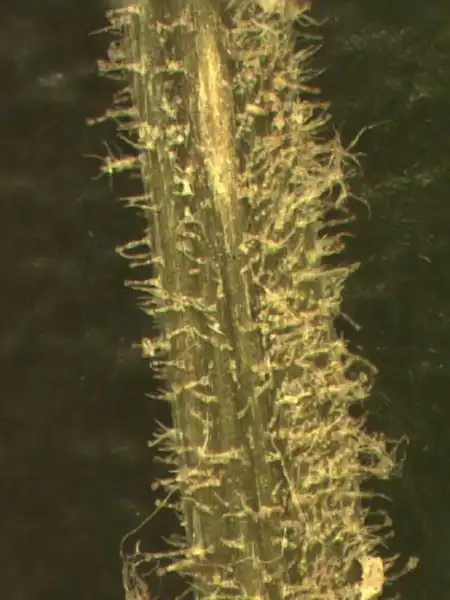
• Photo of Cerastium holosteoides (Cerastium holosteoidess)

Plant Profile: Cerastium holosteoides

Taxonomy: Cerastium holosteoides

Names

Mouseear Chickweed

  • Photo of Cerastium holosteoides (Cerastium holosteoidess)

Phonetic Spelling:ser-RAS-tee-um hol-os-tee-OY-deez

Genus:Cerastium

Species:holosteoides

Family:Caryophyllaceae

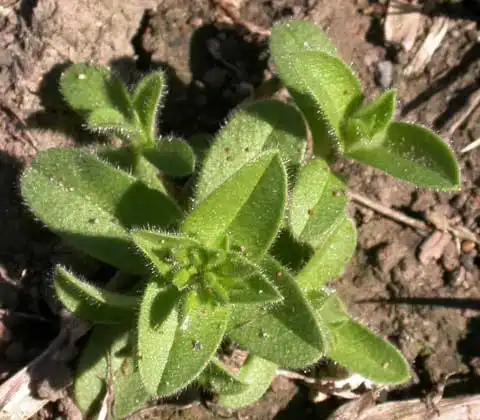
Mouseear chickweed belongs to the Caryophyllaceae family. This plant is characterized as a cool-season annual or a short-lived perennial, featuring distinctly hairy stems and leaves. The leaves are dark green, arranged oppositely, and have a blunt tip. Its flowers resemble those of common chickweed, displaying five split white petals. Mouseear chickweed tends to form dense mats and can climb into the canopies of crops. It is known for its prolific seed production, with seedlings primarily emerging from fall to spring, although in cooler, moist regions, they may continue to sprout throughout the summer. Most preemergence herbicides labeled for use are effective in managing this weed.

This species is native to temperate and subarctic regions of Eurasia, extending to New Guinea.

Season: classified as a winter annual weed.

Cerastium holosteoides Feature Summary

Cerastium holosteoides Image Gallery

Tags

#weed
#weedy

Similar Plants

Cerastium holosteoides is often confused with:

Cerastium holosteoides Feature Summary

Flowers
Flowers are very similar to common chickweed, white with 5 split petals
4-5 petals/rays
Leaves
Leaves are dark green in color, opposite and bluntly pointed
Whole Plant Traits
Annual
Weed
Landscape

Cerastium holosteoides Flowers

Cerastium holosteoides: Flower Description

Flowers are very similar to common chickweed, white with 5 split petals
Cerastium holosteoides: Flower Color

filter_vintage
White

Cerastium holosteoides: Flower Petals

2-3 rays/petals
4-5 petals/rays
6 petals/rays
7 - 20 petals/rays
asymmetrical petals
Bracts
Colored Sepals
fused petals
more than 20 petals/rays
Tepals

Cerastium holosteoides Leaves

Cerastium holosteoides: Leaf Description

Leaves are dark green in color, opposite and bluntly pointed

Cerastium holosteoides: Leaf Color

spa
Green

Cerastium holosteoides: Leaf Arrangement

Alternate
Opposite
Other/more complex
Rosulate
Whorled

Cerastium holosteoides: Hairs Present

No
Yes

Cerastium holosteoides Attributes

Cerastium holosteoides: Life Cycle

Annual
Biennial
Bulb
Perennial
Woody

Cerastium holosteoides: Recommended Propagation Strategy

Division
Grafting
Layering
Leaf Cutting
Root Cutting
Seed
Stem Cutting

Cerastium holosteoides Whole Plant Traits

Cerastium holosteoides: Plant Type

Annual
Bulb
Carnivorous
Edible
Epiphyte
Fern
Ground Cover
Herb
Herbaceous Perennial
Houseplant
Mushroom
Native Plant
Ornamental Grasses and Sedges
Perennial
Poisonous
Rose
Shrub
Succulent
Tree
Turfgrass
Vegetable
Vine
Water Plant
Weed
Wildflower

Cerastium holosteoides: Habit/Form

Arching
Ascending
Broad
Cascading
Climbing
Clumping
Columnar
Conical
Creeping
Dense
Erect
Horizontal
Irregular
Mounding
Multi-stemmed
Multi-trunked
Open
Oval
Prostrate
Pyramidal
Rounded
Spreading
Vase
Weeping

Cerastium holosteoides Stem

Cerastium holosteoides: Stem Is Aromatic

No
Yes

Cerastium holosteoides Landscape

Cerastium holosteoides: Problems

Allelopathic
Contact Dermatitis
Frequent Disease Problems
Frequent Insect Problems
Invasive Species
Malodorous
Messy
Poisonous to Humans
Problem for Cats
Problem for Children
Problem for Dogs
Problem for Horses
Short-lived
Spines/Thorns
Weak Wood
Weedy