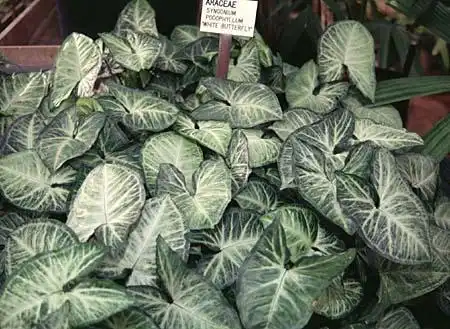
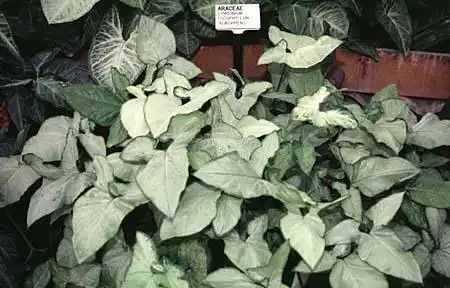
• Photo of Syngonium podophyllum (Syngonium podophyllums)

Plant Profile: Syngonium podophyllum

Taxonomy: Syngonium podophyllum

Names

African Evergreen, Arrow-Head Vine, Arrowhead Vine, Green Gold Naphthysis, Nephthytis, Trileaf Wonder

  • Photo of Syngonium podophyllum (Syngonium podophyllums)

Phonetic Spelling:sin-GO-nee-um po-do-FIL-um

Genus:Syngonium

Species:podophyllum

Family:Araceae

This evergreen tropical perennial shrub can grow up to 16 inches tall and climb as high as 2 meters. It is favored for indoor environments due to its low maintenance requirements, featuring either solid green or variegated leaves with long petioles and a bushy appearance, complemented by some cascading stems. While it rarely flowers indoors, its juvenile stage showcases arrow-shaped leaves, whereas the adult form displays palmately divided leaves with 3 to 11 segments, along with lobed leaves that signify the transition from juvenile to adult. Typically, the juvenile varieties are the ones available for purchase. This plant can be utilized as a hanging basket, ground cover, climbing plant, or small shrub.

Quick Identification

Consumption of this plant can lead to intense oral pain.

Syngonium podophyllum Feature Summary

Syngonium podophyllum Image Gallery

Tags

#evergreen
#poisonous
#perennial
#spadix
#fantz
#problem for cats
#problem for dogs
#problem for horses

Similar Plants

Syngonium podophyllum is often confused with:

Syngonium podophyllum Feature Summary

Attributes
South America to Mexico
Perennial
Fruit
Fruit is a cluster of round berries.
Flowers
Inflorescence is a spathe cluster, axillary, spadix shorter than spathe; spathes overlap to form boat-shaped tube, green to yellow and white, sometimes marked with red or purple.
Purple/Lavender
White
Gold/Yellow
Red/Burgundy
Green
Leaves
Juvenile leaves alternate, simple, saggitate, acute to acuminate, and entire. They are dark green above, paler green beneath; intermediate leaves 3-lobed, median segments constricted at base, basal segment triangular. Adult leaves are pedatisect, segments 3-11, confluent to free, median segment obovate to elliptic, acuminate, lowermost segment auriculate, dark green above and paler beneath. Petioles are long, green to reddish-green, subpeltate, sheathing at base.
Lanceolate
Stem
Stems are succulent, green, climbing, with adventitious roots.
Poisonous to Humans
Oral irritation, pain and swelling of mouth, tongue, and lips, excessive drooling, vomiting (not horses), difficulty swallowing
Calcium oxalate crystals
Seeds
Leaves
Stems
Sap/Juice
Flowers
Roots
Whole Plant Traits
Perennial
Poisonous
Houseplant
Herb
Cultural Conditions
Dappled Sunlight (Shade through upper canopy all day)
Landscape
Problem for Cats
Problem for Dogs
Problem for Horses

Syngonium podophyllum Attributes

Syngonium podophyllum: Country Or Region Of Origin

South America to Mexico
Syngonium podophyllum: Life Cycle

Annual
Biennial
Bulb
Perennial
Woody

Syngonium podophyllum Fruit

Syngonium podophyllum: Fruit Description

Fruit is a cluster of round berries.

Syngonium podophyllum Flowers

Syngonium podophyllum: Flower Description

Inflorescence is a spathe cluster, axillary, spadix shorter than spathe; spathes overlap to form boat-shaped tube, green to yellow and white, sometimes marked with red or purple.

Syngonium podophyllum: Flower Color

filter_vintage
Gold/Yellow
filter_vintage
Green
filter_vintage
Purple/Lavender
filter_vintage
Red/Burgundy
filter_vintage
White

Syngonium podophyllum: Flower Inflorescence

Catkin
Corymb
Cyme
Head
Insignificant
Panicle
Raceme
Solitary
Spadix
Spike
Umbel

Syngonium podophyllum Leaves

Syngonium podophyllum: Leaf Description

Juvenile leaves alternate, simple, saggitate, acute to acuminate, and entire. They are dark green above, paler green beneath; intermediate leaves 3-lobed, median segments constricted at base, basal segment triangular. Adult leaves are pedatisect, segments 3-11, confluent to free, median segment obovate to elliptic, acuminate, lowermost segment auriculate, dark green above and paler beneath. Petioles are long, green to reddish-green, subpeltate, sheathing at base.

Syngonium podophyllum: Leaf Color

spa
Green

Syngonium podophyllum: Leaf Type

Compound (Pinnately , Bipinnately, Palmately)
Fronds
Needles
Sheath
Simple

Syngonium podophyllum: Leaf Arrangement

Alternate
Opposite
Other/more complex
Rosulate
Whorled

Syngonium podophyllum: Leaf Shape

Acicular
Auriculate
Cordate
Cuneate
Deltoid
Elliptical
Filiform
Lanceolate
Linear
Oblanceolate
Oblong
Obovate
Obtuse
Orbicular
Ovate
Palmasect
Palmatifid
Peltate
Pinnatifid
Pinnatisect
Reniform
Rhomboidal
Spatulate
Subcordate
Subulate

Syngonium podophyllum: Hairs Present

No
Yes

Syngonium podophyllum Stem

Syngonium podophyllum: Stem Description

Stems are succulent, green, climbing, with adventitious roots.

Syngonium podophyllum: Stem Color

grass
Green

Syngonium podophyllum: Stem Is Aromatic

No
Yes

Syngonium podophyllum Poisonous to Humans

Syngonium podophyllum: Poison Symptoms

Oral irritation, pain and swelling of mouth, tongue, and lips, excessive drooling, vomiting (not horses), difficulty swallowing

Syngonium podophyllum: Poison Toxic Principle

Calcium oxalate crystals

Syngonium podophyllum: Poison Severity

High
Low
Medium

Syngonium podophyllum: Causes Contact Dermatitis

No
Yes

Syngonium podophyllum: Poison Part

Bark
Flowers
Fruits
Leaves
Roots
Sap/Juice
Seeds
Stems

Syngonium podophyllum Whole Plant Traits

Syngonium podophyllum: Plant Type

Annual
Bulb
Carnivorous
Edible
Epiphyte
Fern
Ground Cover
Herb
Herbaceous Perennial
Houseplant
Mushroom
Native Plant
Ornamental Grasses and Sedges
Perennial
Poisonous
Rose
Shrub
Succulent
Tree
Turfgrass
Vegetable
Vine
Water Plant
Weed
Wildflower

Syngonium podophyllum Cultural Conditions

Syngonium podophyllum: Light

Dappled Sunlight (Shade through upper canopy all day)
Deep shade (Less than 2 hours to no direct sunlight)
Full sun (6 or more hours of direct sunlight a day)
Partial Shade (Direct sunlight only part of the day, 2-6 hours)

Syngonium podophyllum: Soil Drainage

Frequent Standing Water
Good Drainage
Moist
Occasional Flooding
Occasionally Dry
Occasionally Wet
Very Dry

Syngonium podophyllum Landscape

Syngonium podophyllum: Problems

Allelopathic
Contact Dermatitis
Frequent Disease Problems
Frequent Insect Problems
Invasive Species
Malodorous
Messy
Poisonous to Humans
Problem for Cats
Problem for Children
Problem for Dogs
Problem for Horses
Short-lived
Spines/Thorns
Weak Wood
Weedy