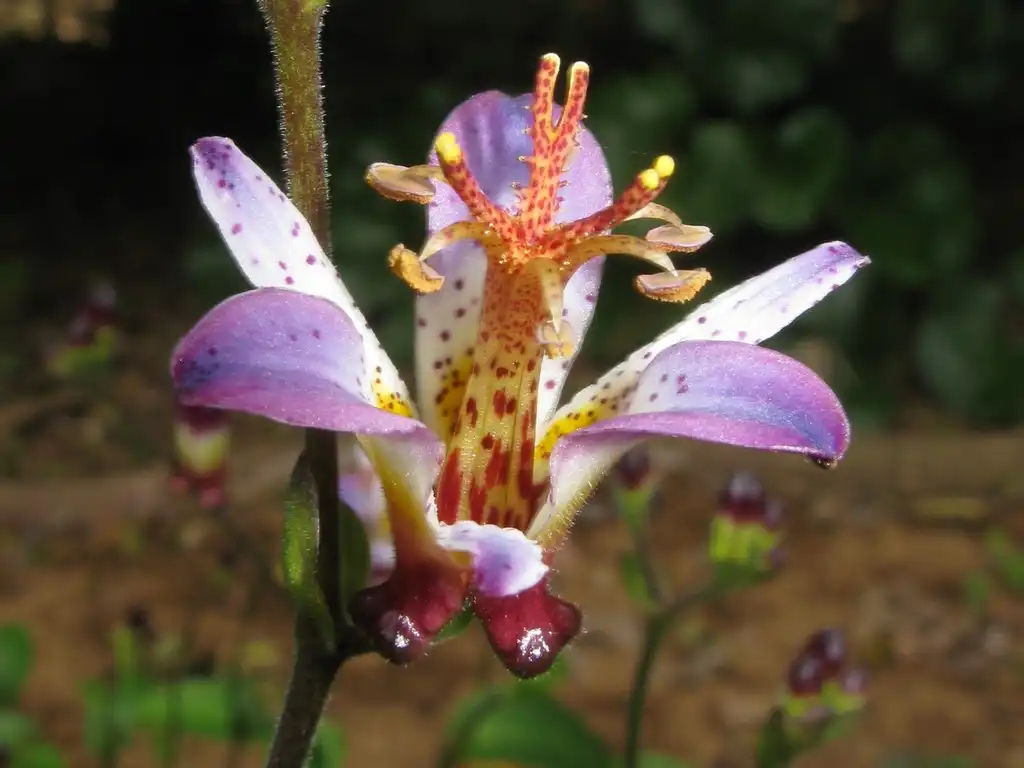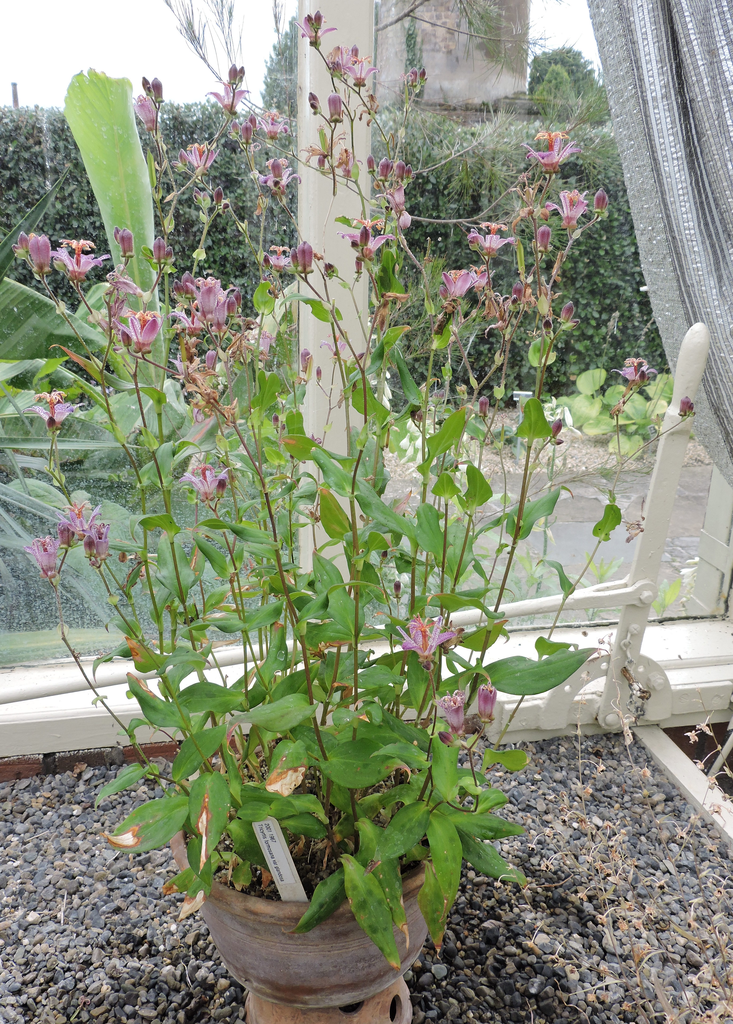
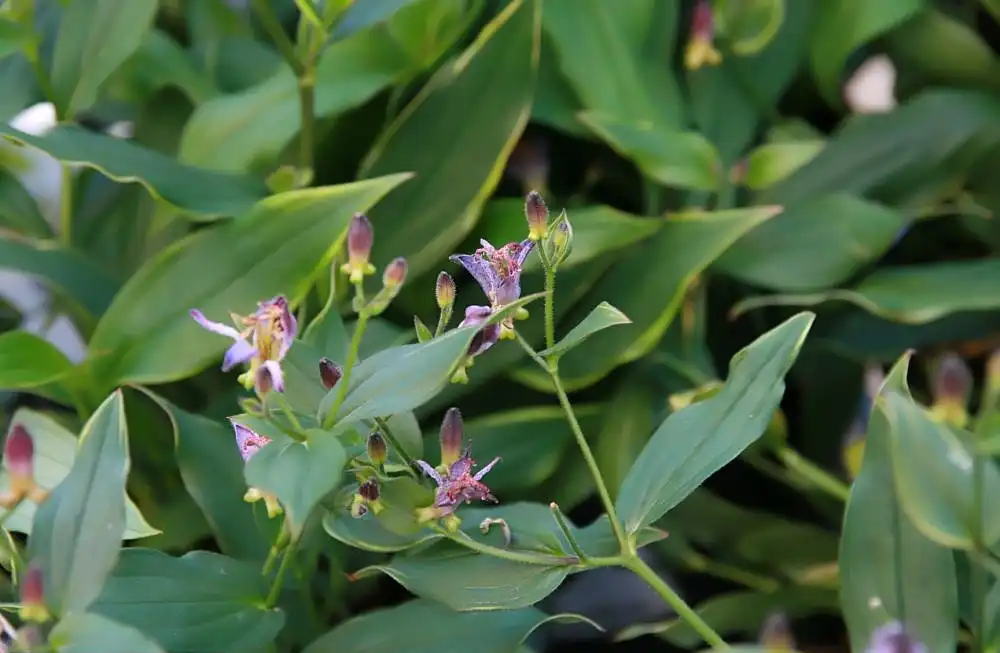
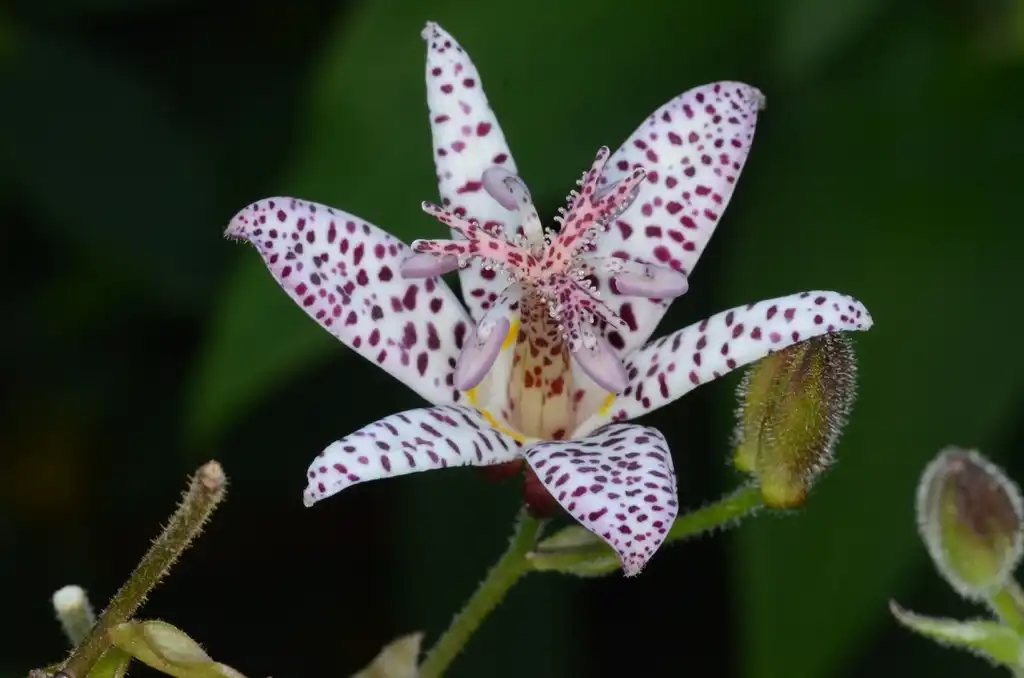
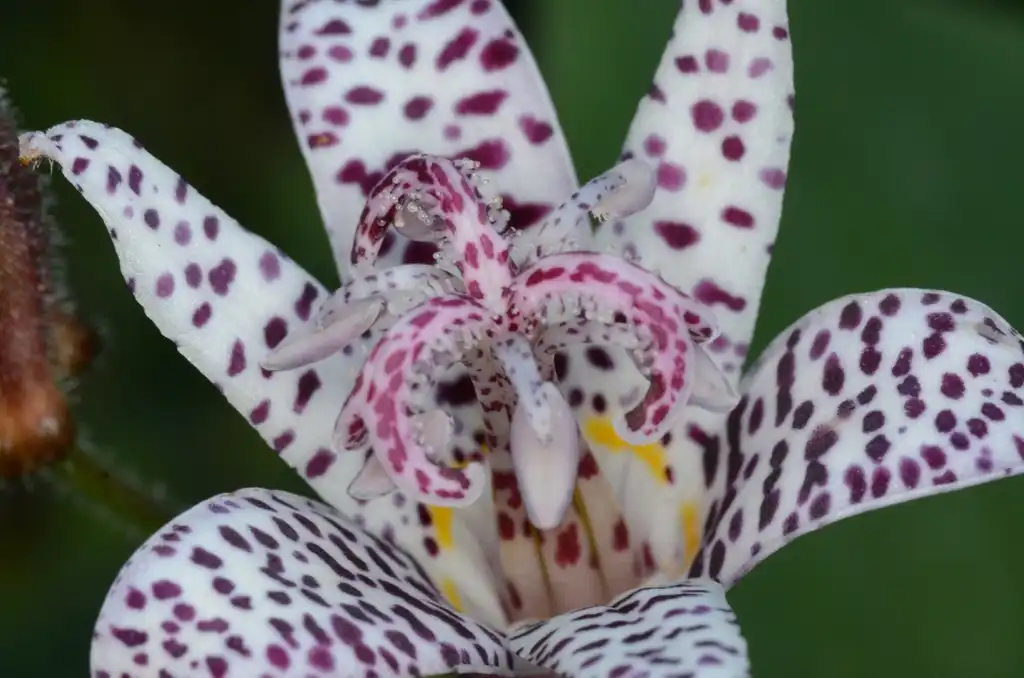
• Photo of Tricyrtis formosana (Tricyrtis formosanas)

Plant Profile: Tricyrtis formosana

Names

Formosan Toad Lily, Toad Lily

  • Photo of Tricyrtis formosana (Tricyrtis formosanas)

Phonetic Spelling:

Genus:Tricyrtis

Species:formosana

Family:Liliaceae

The Toad Lily, also known as the Formosan Toad Lily, is a striking perennial from the lily family that thrives in shady environments and features small, orchid-like blooms. The genus name "Tricyrtis" derives from Greek, where "tri" signifies three and "kyrtos" refers to a swelling or bulging shape. This nomenclature highlights the three sac-like nectaries located at the base of the tepals, which consist of three inner petals and three outer sepals. The species name "formosana" indicates its origin in Formosa, the historical name for present-day Taiwan.

The term "Toad Lily" is inspired by the flower's spotted appearance, reminiscent of toads, along with the warty, sac-like bumps that represent the nectaries. The Tricyrtis genus is indigenous to regions including China, Korea, Japan, Nepal, Taiwan, and the Philippines. These flowers typically grow at the edges of forests, near creek beds, and along roadways. While the Tricyrtis genus encompasses around 20 species, only Tricyrtis formosana and Tricyrtis hirta are commonly found in gardens, with the Toad Lily being native to Taiwan.

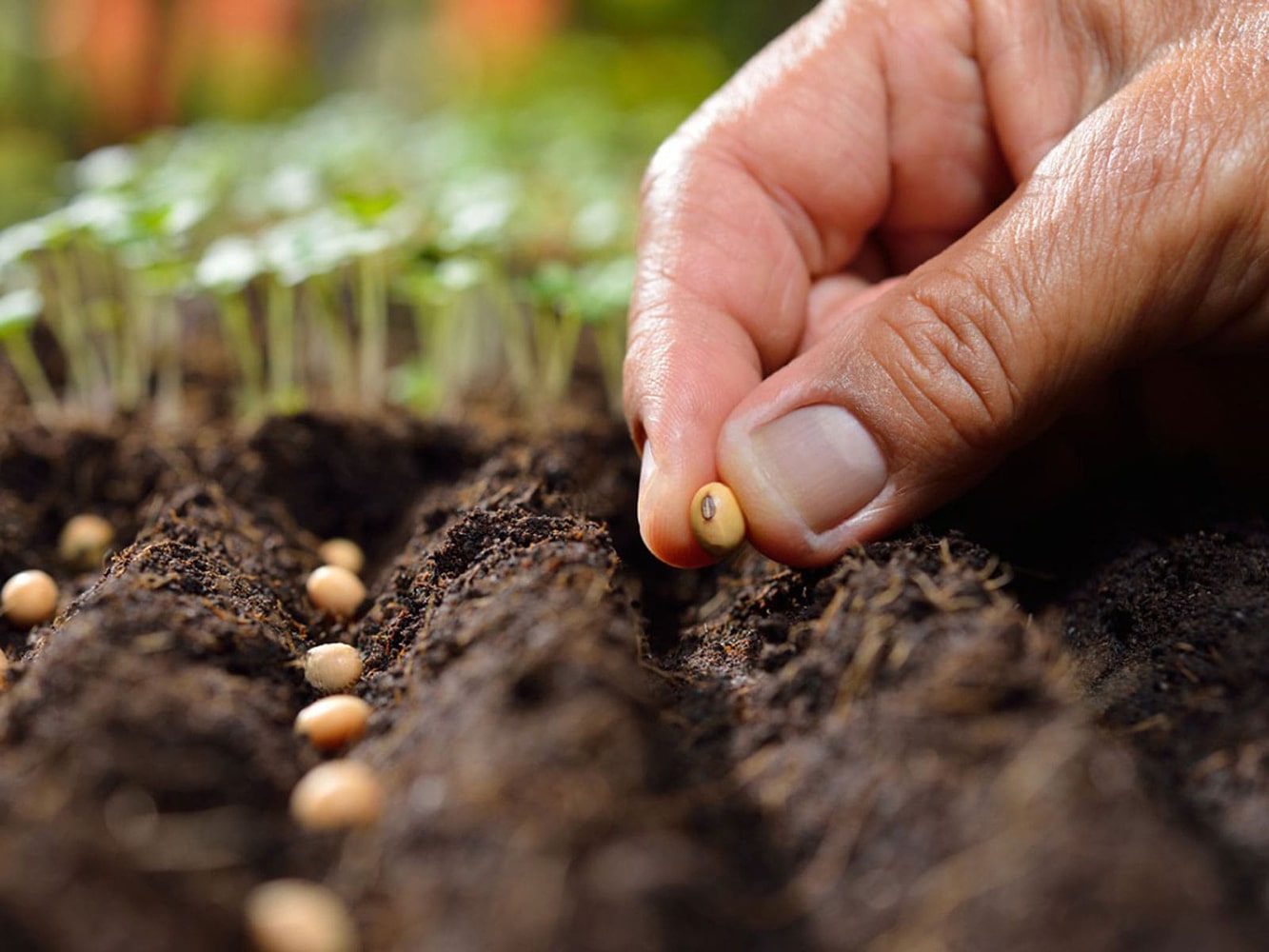
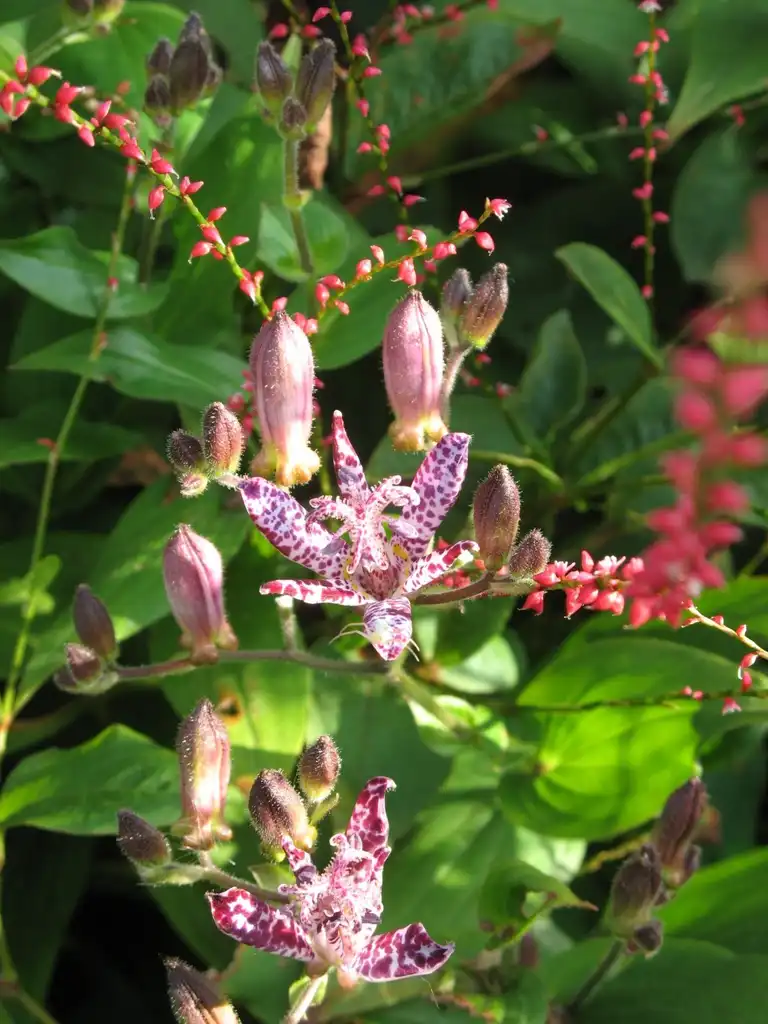
This plant features an upright stem that can reach heights of up to 40 inches, adorned with glossy leaves. Clusters of small flowers, which are white with reddish-purple speckles, bloom at the stem's tip. Notably, the flowers of this species are smaller compared to many others. The Toad Lily propagates through underground rhizomes and can also be grown from seeds, stem cuttings, or divisions. Seeds should be harvested in late fall when the capsules open, and they must be sown fresh without being buried in soil. Some species may require cold stratification for germination. Divisions should be performed in spring, ensuring that each piece includes an underground growth bud for successful establishment. Stem cuttings root easily during the summer months.

The Toad Lily prefers light, open shade and does not thrive in deep shade; exposure to full sun can scorch its leaves. Prolonged exposure to temperatures below 28 degrees Fahrenheit can severely damage the plant.

In recent years, Toad Lilies have made their way into gardens across the United States, gaining popularity in ornamental settings since the mid-1990s. They are resistant to deer, though slugs and snails may occasionally pose a threat. Rabbits are known to nibble on new growth. The Tricyrtis floral virus, transmitted by aphids, can cause the flower's color to become mottled before turning entirely purple. Additionally, anthracnose, a fungal disease, can lead to orange spots on the stems and leaves, which can be mitigated by keeping the foliage dry and watering only at the plant's base.

To fully appreciate Toad Lilies, they are best viewed up close, such as along borders or pathways. They enhance shade gardens when paired with plants like hostas, ferns, and astilbe, and they also serve well as cut flowers. Various cultivars exhibit variegated foliage, and some showcase purple flowers adorned with dark spots.

Alternative native plants that complement the Toad Lily include Mimulus ringens, Viola canadensis, Clinopodium nepeta, and Verbena.

In terms of pests and diseases, slugs and snails may be attracted to the Toad Lily, while Tricyrtis floral virus and anthracnose are common ailments affecting the plant.

Tricyrtis formosana Feature Summary

Tricyrtis formosana Image Gallery

Tags

#perennial
#herbaceous perennial

Similar Plants

Tricyrtis formosana is often confused with:

Tricyrtis formosana Feature Summary

Attributes
Taiwan, Nansei-shoto Islands--Ryukyu
Small mammals feed on new growth. Hummingbirds feed on the nectar. It is pollinated by bees.
Perennial
Seed
Stem Cutting
Division
Wildlife Food Source
Attracts Pollinators
Fruit
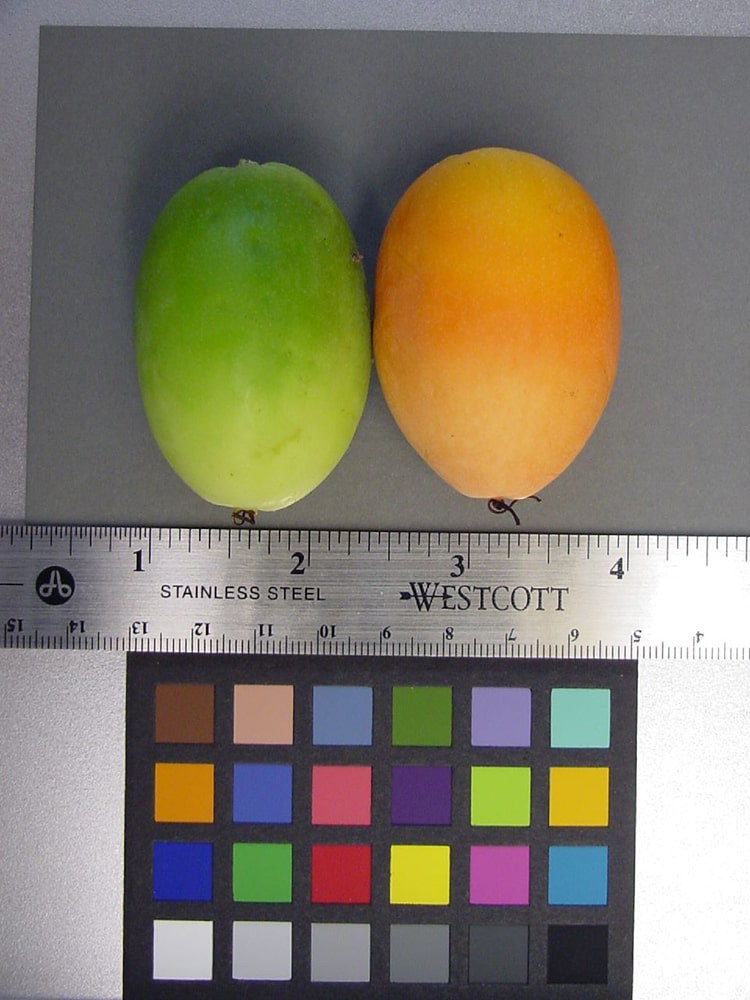
After flowering, the cylinder shaped seed capsules open and inside are tiny round, flat, papery seeds. The seeds should be harvested in the fall. Plant the seeds when they are fresh and do not cover with soil. They typically require cold stratification before they will germinate.
< 1 inch
Flowers
The flower is small, about 1 inch long. It is star-shaped, lily or orchid-like. There are 6 showy tepals which include 3 inner petals and 3 outer sepals of similar appearance. The flowers bloom in cymes or branched clusters like day lilies. They are primarily at the top of the stem of the plant. The Toad Lily is white with reddish purple freckles and yellow throats or centers. There are three sac-like nectaries at the base of the tepals. They bloom late summer to early fall.
Purple/Lavender
White
Gold/Yellow
Red/Burgundy
1-3 inches
Leaves
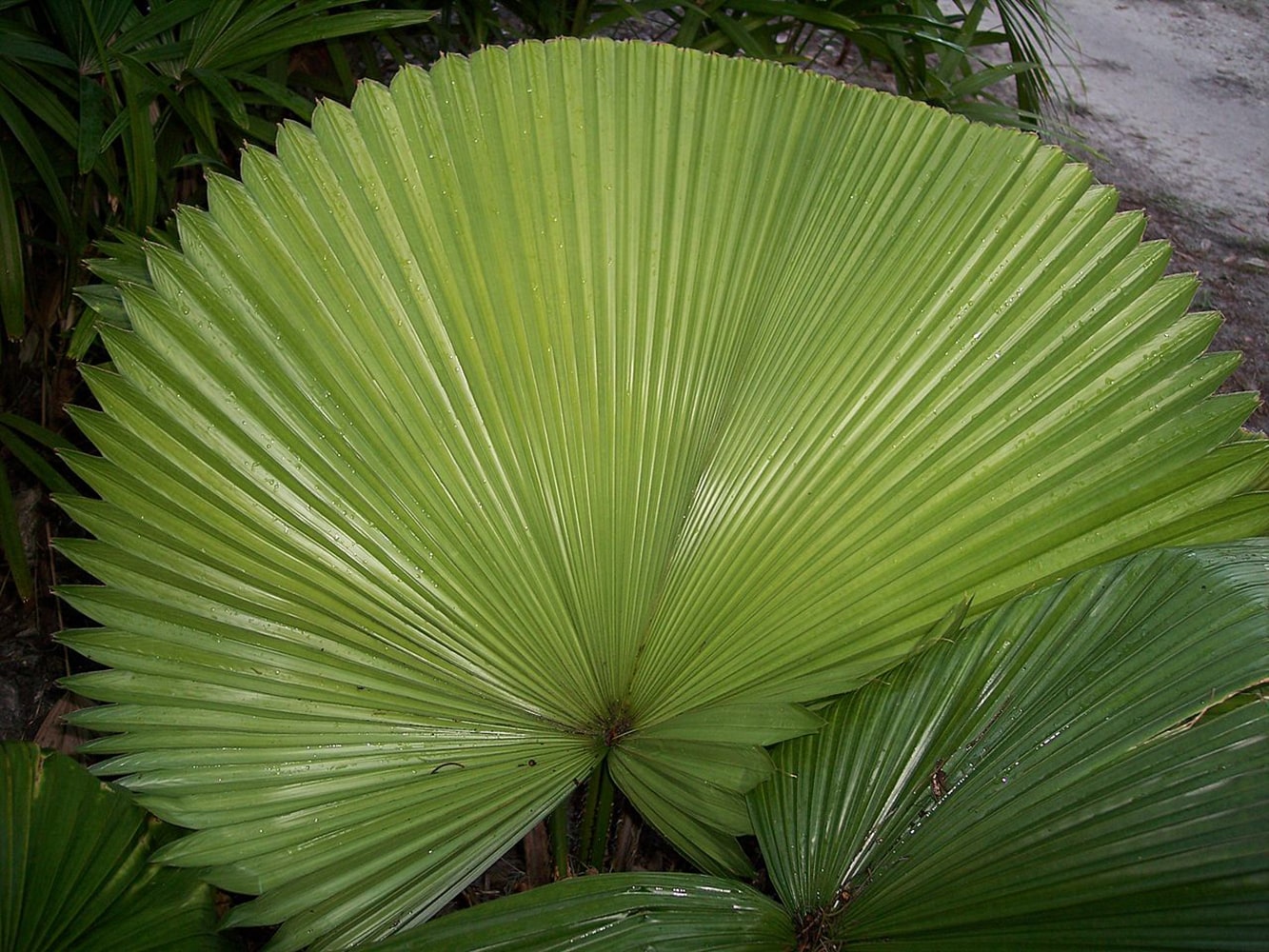
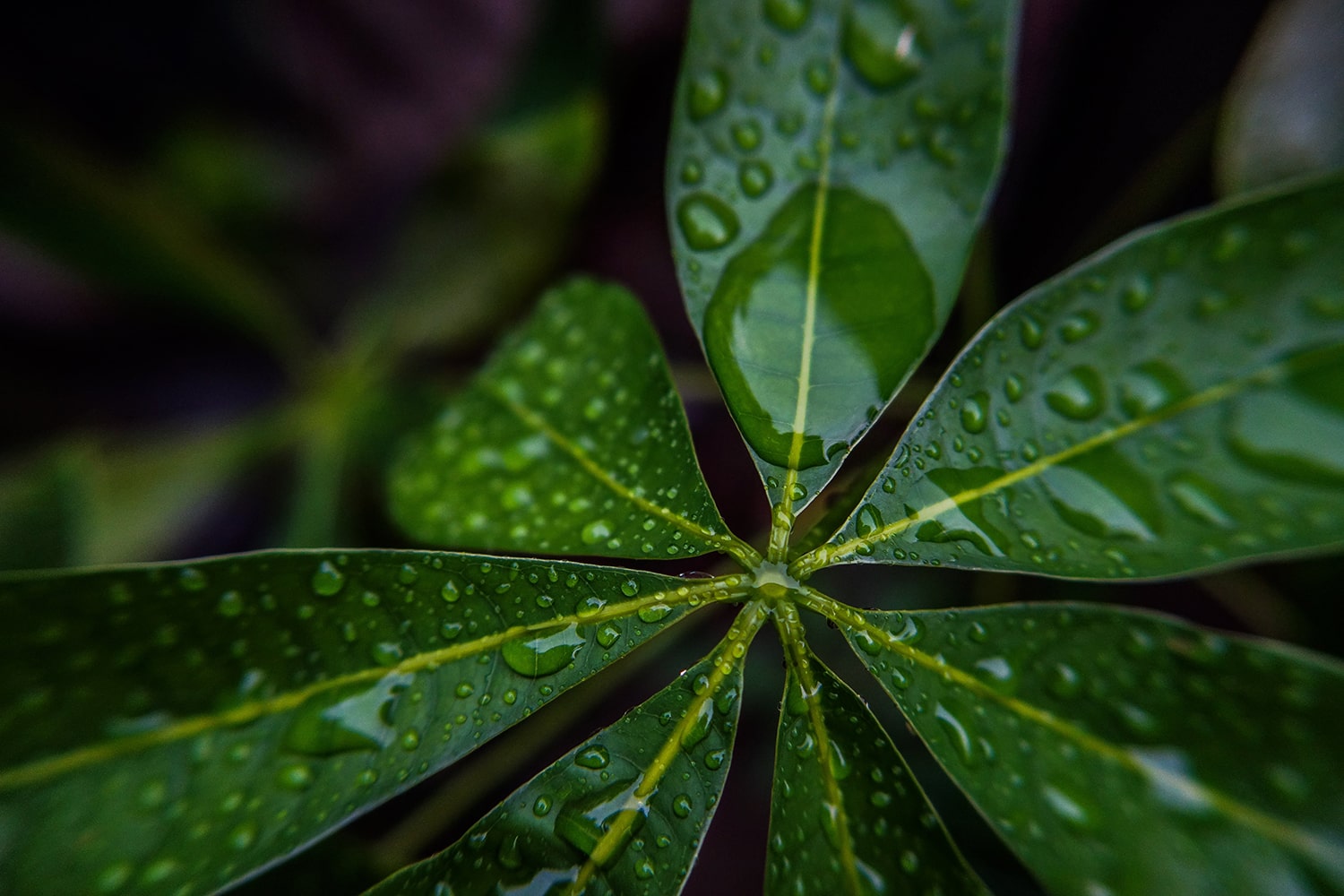
The leaves are lanceolate to obovate, shiny, and dark green in color. They have fine transparent hairs on the undersides. They clasp at the leaf base. Depending on the cultivar, the color of the leaves may vary from green to green with yellow/gold edges or gold to gold with creamy white edges.
Green
White
Gold/Yellow
Lanceolate
Obovate
3-6 inches
Stem
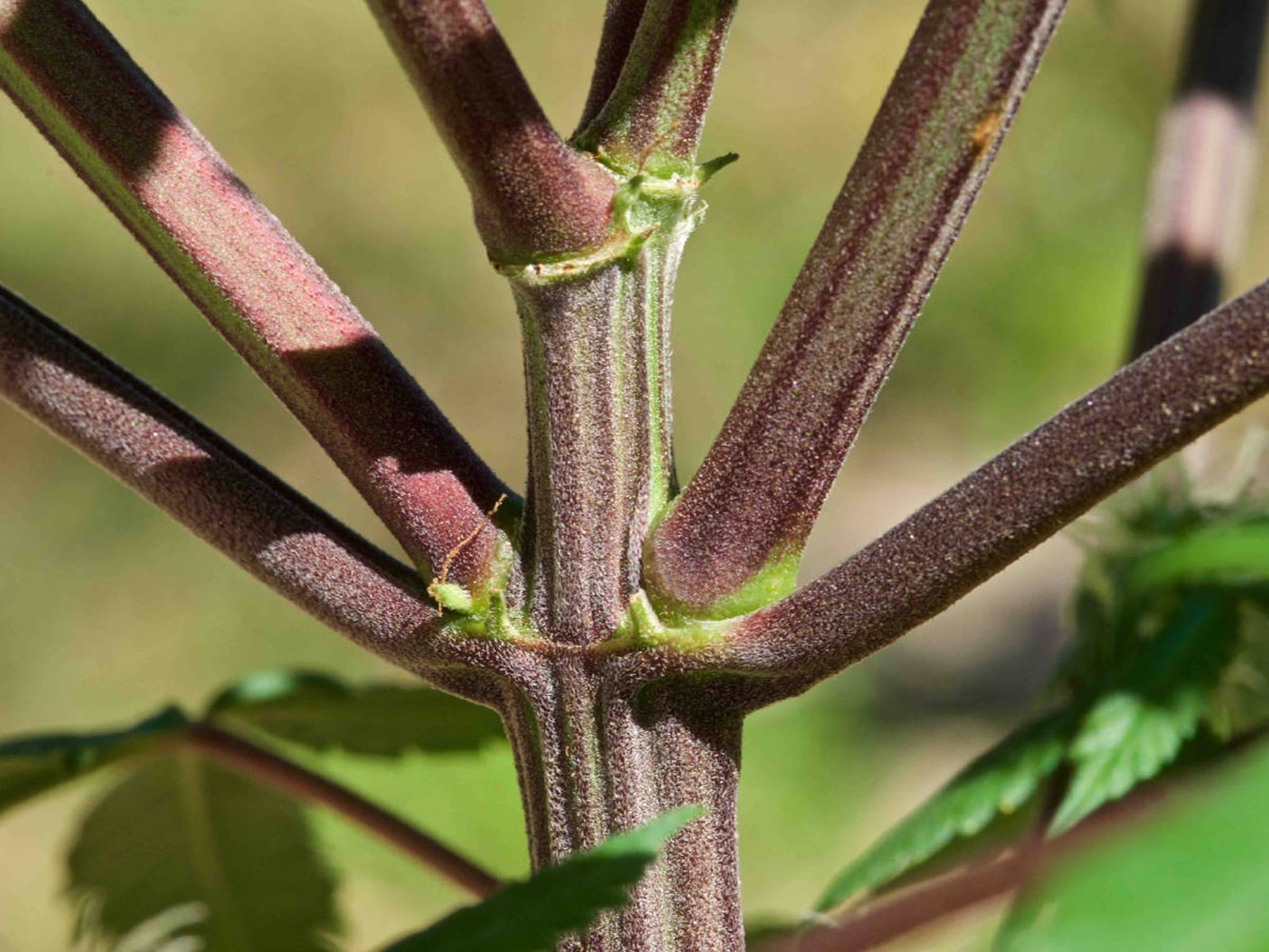
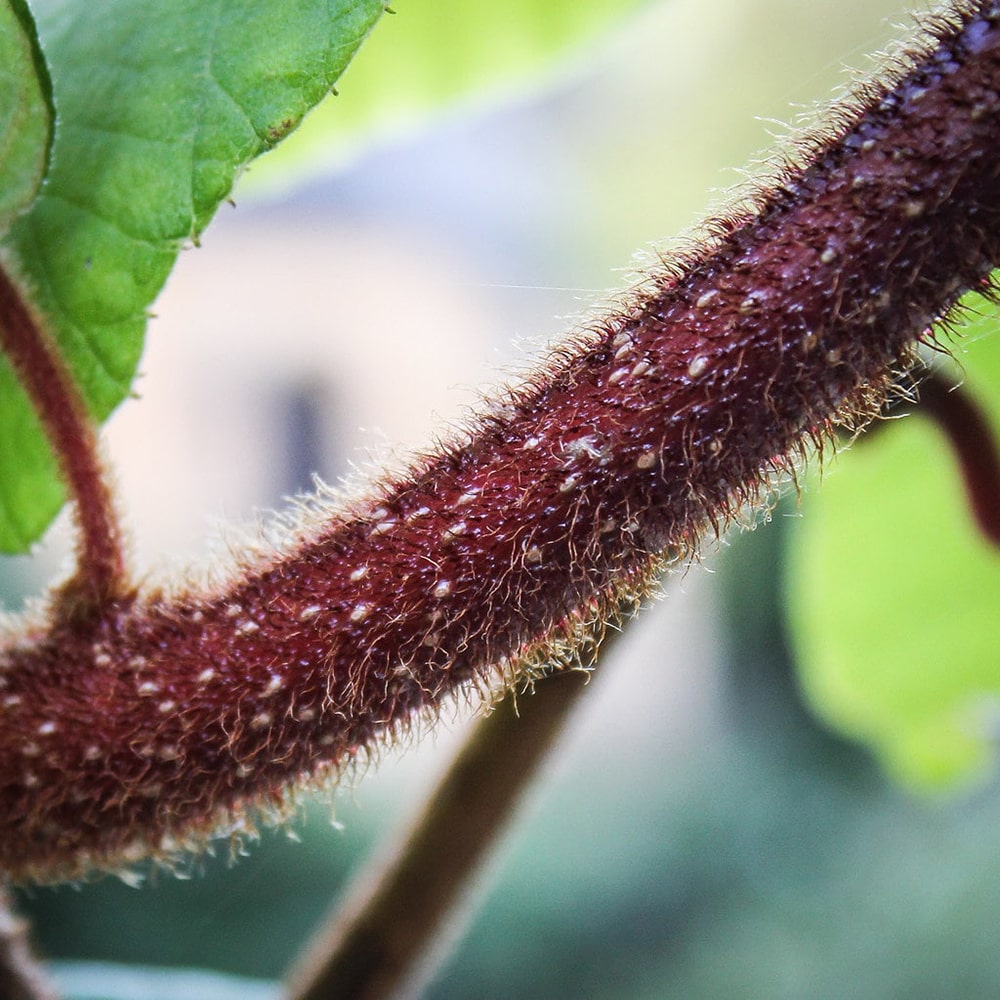
The stem is erect and measures from 24" to 40" tall. The stem has fine transparent hairs.
Straight
Whole Plant Traits
Perennial
Herbaceous Perennial
Cultural Conditions
Partial Shade (Direct sunlight only part of the day, 2-6 hours)
Deep shade (Less than 2 hours to no direct sunlight)
Acid (<6.0)
Neutral (6.0-8.0)
Good Drainage
Moist
Occasionally Wet
Coastal
Mountains
Piedmont
Loam (Silt)
Sand
Landscape
Cutting Garden
Rock Garden
Pollinator Garden
Cottage Garden
Shade Garden
Border
Mass Planting
Accent
Specimen
Container
Patio
Walkways
Woodland
Meadow
Naturalized Area
Bees
Small Mammals
Hummingbirds

Tricyrtis formosana Attributes

Tricyrtis formosana: Country Or Region Of Origin

Taiwan, Nansei-shoto Islands--Ryukyu
Tricyrtis formosana: Wildlife Value

Small mammals feed on new growth. Hummingbirds feed on the nectar. It is pollinated by bees.

Tricyrtis formosana: Life Cycle

Annual
Biennial
Bulb
Perennial
Woody

Tricyrtis formosana: Recommended Propagation Strategy

Division
Grafting
Layering
Leaf Cutting
Root Cutting
Seed
Stem Cutting

Tricyrtis formosana: Play Value

Attractive Flowers
Attracts Pollinators
Buffer
Colorful
Defines Paths
Easy to Grow
Edible fruit
Fragrance
Pieces Used in Games
Screening
Shade
Sound
Textural
Wildlife Cover/Habitat
Wildlife Food Source
Wildlife Larval Host
Wildlife Nesting
Wind Break
Wind Shimmer

Tricyrtis formosana Fruit

Tricyrtis formosana: Fruit Description

After flowering, the cylinder shaped seed capsules open and inside are tiny round, flat, papery seeds. The seeds should be harvested in the fall. Plant the seeds when they are fresh and do not cover with soil. They typically require cold stratification before they will germinate.
Tricyrtis formosana: Fruit Type

Achene
Aggregate
Berry

Capsule
Caryopsis
Drupe
Follicle
Legume
Nut
Pome
Samara
Schizocarp
Siliqua

Tricyrtis formosana: Display/Harvest Time

Fall
Spring
Summer
Winter

Tricyrtis formosana: Fruit Length

< 1 inch
1-3 inches
> 3 inches

Tricyrtis formosana: Fruit Width

< 1 inch
1-3 inches
> 3 inches

Tricyrtis formosana Flowers

Tricyrtis formosana: Flower Description

The flower is small, about 1 inch long. It is star-shaped, lily or orchid-like. There are 6 showy tepals which include 3 inner petals and 3 outer sepals of similar appearance. The flowers bloom in cymes or branched clusters like day lilies. They are primarily at the top of the stem of the plant. The Toad Lily is white with reddish purple freckles and yellow throats or centers. There are three sac-like nectaries at the base of the tepals. They bloom late summer to early fall.

Tricyrtis formosana: Flower Color

filter_vintage
Gold/Yellow
filter_vintage
Purple/Lavender
filter_vintage
Red/Burgundy
filter_vintage
White

Tricyrtis formosana: Flower Inflorescence

Catkin
Corymb
Cyme
Head
Insignificant
Panicle
Raceme
Solitary
Spadix
Spike
Umbel

Tricyrtis formosana: Flower Value To Gardener

Edible
Fragrant
Good Cut
Good Dried
Long Bloom Season
Long-lasting
Showy

Tricyrtis formosana: Flower Bloom Time

Winter
Spring
Summer
Fall

Tricyrtis formosana: Flower Petals

2-3 rays/petals
4-5 petals/rays
6 petals/rays
7 - 20 petals/rays
asymmetrical petals
Bracts
Colored Sepals
fused petals
more than 20 petals/rays
Tepals

Tricyrtis formosana: Flower Size

1-3 inches
3-6 inches
< 1 inch
> 6 inches

Tricyrtis formosana Leaves

Tricyrtis formosana: Leaf Description

The leaves are lanceolate to obovate, shiny, and dark green in color. They have fine transparent hairs on the undersides. They clasp at the leaf base. Depending on the cultivar, the color of the leaves may vary from green to green with yellow/gold edges or gold to gold with creamy white edges.

Tricyrtis formosana: Leaf Color

spa
Gold/Yellow
spa
Green
spa
White

Tricyrtis formosana: Leaf Arrangement

Alternate
Opposite
Other/more complex
Rosulate
Whorled

Tricyrtis formosana: Leaf Shape

Acicular
Auriculate
Cordate
Cuneate
Deltoid
Elliptical
Filiform
Lanceolate
Linear
Oblanceolate
Oblong
Obovate
Obtuse
Orbicular
Ovate
Palmasect
Palmatifid
Peltate
Pinnatifid
Pinnatisect
Reniform
Rhomboidal
Spatulate
Subcordate
Subulate

Tricyrtis formosana: Hairs Present

No
Yes

Tricyrtis formosana: Leaf Length

< 1 inch
1-3 inches
3-6 inches
> 6 inches

Tricyrtis formosana: Leaf Feel

Fleshy
Glossy
Leathery
Papery
Prickly
Rough
Rubbery
Slippery
Smooth
Soft
Velvety
Waxy

Tricyrtis formosana Stem

Tricyrtis formosana: Stem Description

The stem is erect and measures from 24" to 40" tall. The stem has fine transparent hairs.

Tricyrtis formosana: Stem Color

grass
Green

Tricyrtis formosana: Stem Is Aromatic

No
Yes

Tricyrtis formosana: Stem Form

Straight
Zig Zags

Tricyrtis formosana Whole Plant Traits

Tricyrtis formosana: Plant Type

Annual
Bulb
Carnivorous
Edible
Epiphyte
Fern
Ground Cover
Herb
Herbaceous Perennial
Houseplant
Mushroom
Native Plant
Ornamental Grasses and Sedges
Perennial
Poisonous
Rose
Shrub
Succulent
Tree
Turfgrass
Vegetable
Vine
Water Plant
Weed
Wildflower

Tricyrtis formosana Cultural Conditions

Tricyrtis formosana: Light

Dappled Sunlight (Shade through upper canopy all day)
Deep shade (Less than 2 hours to no direct sunlight)
Full sun (6 or more hours of direct sunlight a day)
Partial Shade (Direct sunlight only part of the day, 2-6 hours)

Tricyrtis formosana: Soil pH

Acid (<6.0)
Alkaline (>8.0)
Neutral (6.0-8.0)

Tricyrtis formosana: Soil Drainage

Frequent Standing Water
Good Drainage
Moist
Occasional Flooding
Occasionally Dry
Occasionally Wet
Very Dry

Tricyrtis formosana: Available Space To Plant

12 inches-3 feet
12-24 feet
24-60 feet
3 feet-6 feet
6-feet-12 feet
Less than 12 inches
more than 60 feet

Tricyrtis formosana: NC Region

Coastal
Mountains
Piedmont

Tricyrtis formosana: USDA Plant Hardiness Zone

thermostat
6a
thermostat
6b
thermostat
7a
thermostat
7b
thermostat
8a
thermostat
8b
thermostat
9a
thermostat
9b

Tricyrtis formosana: Soil Texture

Clay
High Organic Matter
Loam (Silt)
Sand
Shallow Rocky

Tricyrtis formosana Landscape

Tricyrtis formosana: Landscape Theme

Asian Garden
Butterfly Garden
Children's Garden
Cottage Garden
Cutting Garden
Drought Tolerant Garden
Edible Garden
English Garden
Fairy Garden
Garden for the Blind
Native Garden
Nighttime Garden
Pollinator Garden
Rain Garden
Rock Garden
Shade Garden
Water Garden
Winter Garden

Tricyrtis formosana: Design Feature

Accent
Barrier
Border
Flowering Tree
Foundation Planting
Hedge
Mass Planting
Screen/Privacy
Security
Shade Tree
Small groups
Small Tree
Specimen
Street Tree
Understory Tree

Tricyrtis formosana: Landscape Location

Coastal
Container
Hanging Baskets
Houseplants
Lawn
Meadow
Naturalized Area
Near Septic
Patio
Pond
Pool/Hardscape
Recreational Play Area
Riparian
Rock Wall
Slope/Bank
Small Space
Vertical Spaces
Walkways
Woodland

Tricyrtis formosana: Attracts

Bats
Bees
Butterflies
Frogs
Hummingbirds
Moths
Pollinators
Predatory Insects
Reptiles
Small Mammals
Songbirds
Specialized Bees