Cardamine concatenata: Uses (Ethnobotany)
The Iroquois Indians used this plant for food and ate the roots either raw or boiled. The plant was also used for medical treatment, including heart conditions, colds, headaches, and stomach pains.
Phonetic Spelling:den-TAY-ree-uh la-sin-ee-AH-ta
Genus:Cardamine
Species:concatenata
Family:Brassicaceae
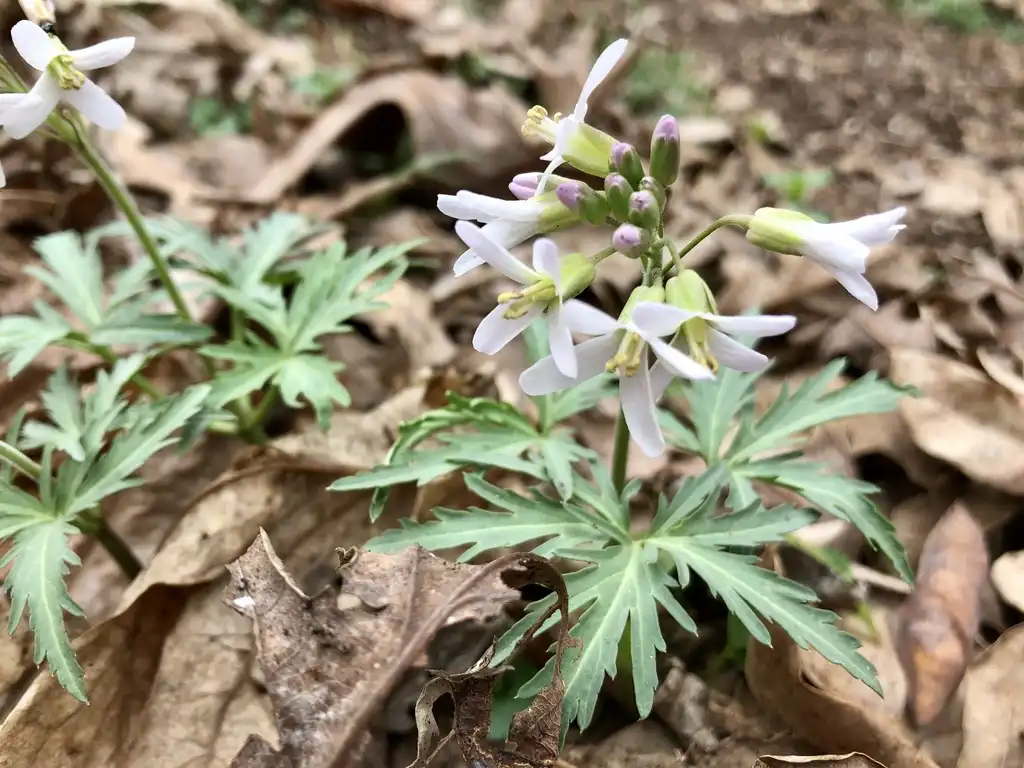
The Cut-leafed Toothwort, also known as Pepper Root, is a perennial wildflower indigenous to the woodlands of eastern Canada and the central and eastern regions of the United States. This plant thrives in rich, moist, and well-drained soils, demonstrating resilience to occasional seasonal flooding. During autumn and winter, it serves as a light ground cover, while its delicate white flowers bloom in the spring, just before the deciduous trees unfurl their leaves. The plant enters a dormant phase during the summer months.
Belonging to the Brassicaceae family, commonly referred to as the mustard family, the genus Cardamine derives from the Greek word "Kardamon," which translates to "cress." The species name, concatenata, comes from Latin, meaning "linked together in a chain." The plant's rhizomes are oblong, fleshy, and jointed, resembling a string of beads. The common name, Pepper Root, highlights the spicy, radish-like flavor of its rhizomes, while Cut-leafed Toothwort refers to the tooth-like projections on its underground stems.
This wildflower produces basal leaves and fertile shoots, with the basal leaves serving to store energy for the following year's growth. The fertile shoot consists of a single flower atop a stalk adorned with a whorl of three deeply lobed leaves. The flowers bloom in terminal clusters, featuring four cross-shaped petals. After blooming, long, slender green pods develop, which open in 4 to 5 weeks to release 10 to 14 small seeds.
Propagation of the Cut-leafed Toothwort can occur through seeds or rhizomes. However, the seeds lose their viability quickly when stored, so it is advisable to sow them immediately after collection. Seedlings typically take 3 to 4 years to bloom. The rhizomes are delicate, making it best to divide them during the plant's dormant period.
Generally, this plant is free from diseases and pests. It serves as a food source for the White-footed mouse and the caterpillars of the Mustard White and West Virginia White butterflies. Additionally, its flowers provide nectar for honeybees and bumblebees.
In perennial or woodland gardens, the Cut-leafed Toothwort adds early spring interest. As it goes dormant in the summer, other perennials can take its place, making it a charming addition to informal or cottage gardens.
The Two-leafed Toothwort bears resemblance to the Cut-leafed Toothwort but is distinguished by having only two leaves on its stalk instead of the three whorled leaves characteristic of its counterpart.
Cardamine concatenata Feature Summary
Cardamine concatenata Image Gallery