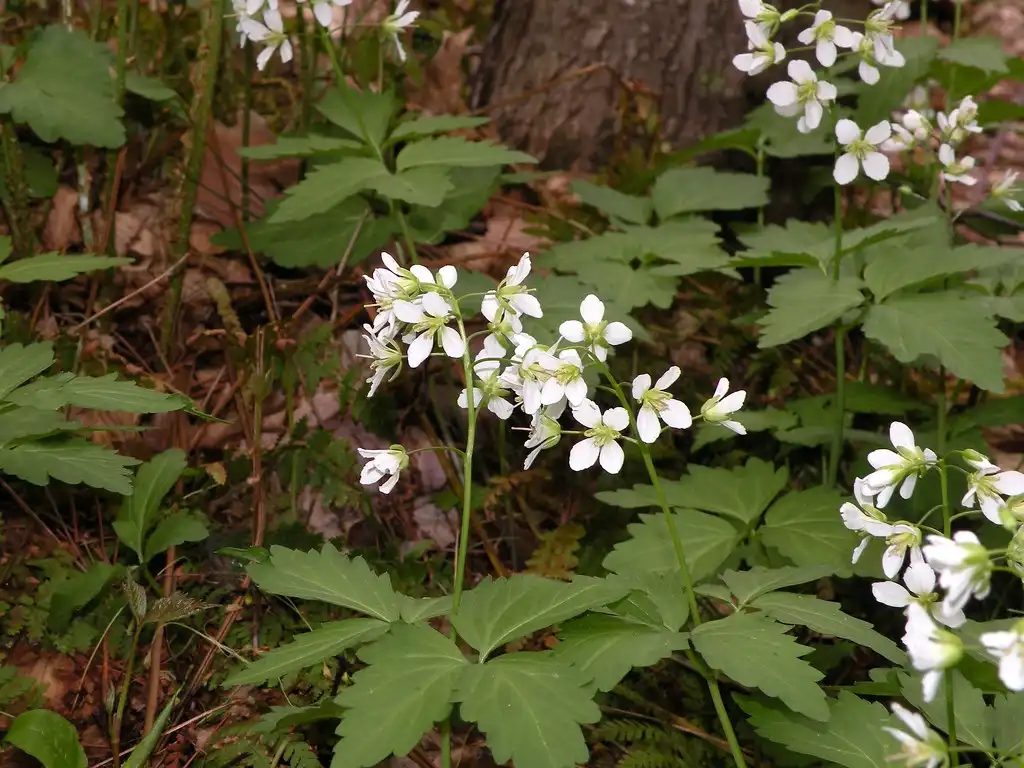
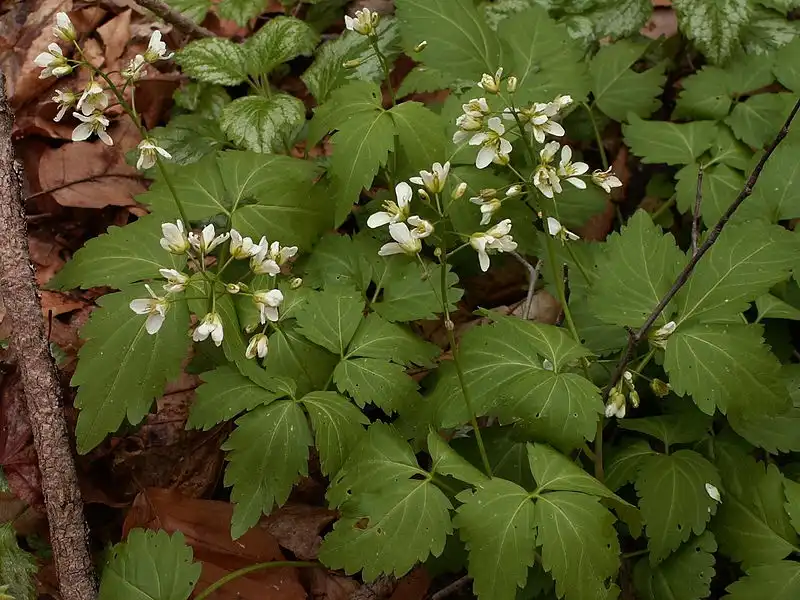
The Two-leaf Toothwort is a perennial plant native to the United States and Eastern Canada. It thrives in rich, moist, and slightly acidic soils found in woodlands or shaded meadows, although it struggles in the deep shade created by evergreen trees. This plant serves as an appealing ground cover during the autumn and winter months, entering dormancy in the summer and propagating through rhizomes. It is particularly well-suited as ground cover beneath Cornus florida.
Belonging to the Brassicaceae family, commonly known as the mustard family, this plant was previously classified under the genus Dentaria but is now categorized as Cardamine. The name "Cardamine" is derived from the Greek term "Kardamon," which refers to cress within the mustard family. The species name, diphylla, translates from Greek to "two-leaved," while "Toothwort" refers to its rootstalk.
In spring, the Two-leaf Toothwort emerges upright, reaching heights of 8 to 16 inches, adorned with paired leaves that feature coarsely serrated edges. From mid-April to mid-May, clusters of white or light pink flowers bloom at the stem's tip. Following the flowering period, pods, or siliqua, develop and open 4 to 5 weeks later, releasing seeds when mature. The seedlings may take 3 to 4 years to flower, and due to their low viability in storage, seeds should be sown immediately after harvesting in a moist, shaded seedbed. For propagation, rootstock division is recommended, ideally when the plant is dormant, but care must be taken as the rhizomes are prone to damage.
The Two-leaf Toothwort bears resemblance to Cardamine concatenata, or Cut-leaved Toothwort, though the latter's leaves are arranged in a whorled pattern.
Both the leaves and roots of the Two-leaf Toothwort are edible, whether consumed raw or cooked.
This plant serves as a crucial habitat for the West Virginia white butterfly, which lays its eggs on it, and it is also a host for the falcate orange-tip butterfly. Additionally, flea beetles feed on its foliage, while specialized bees known as Andrena arabis gather pollen from Cardamine species.